James Simpson

A winding path through the countryside

The Diversity and Inclusion Journey: The Role of Neurodiversity and How to Change Mindsets

In the third of our series looking at current D&I practices, Bradley Honnor from Match Fit and Yasmin Egala, Diversity, Inclusion and Wellbeing Champion at the MOJ discuss whether too much emphasis is placed on physical differences, ignoring hidden differences like neurodiversity, and how to bring those that are resistant to change on board.

Yasmin Egala

If we were to focus more on hidden differences and celebrate those differences for the positives they give us, we might address some of the other big issues that we seem to be going round and round in circles with. Something like neurodiversity cuts across identities. It doesn’t matter what you look like on the outside, what group you belong to, what your background is.  It doesn’t discriminate in that way. I do think that’s an area of diversity and inclusion that has been neglected, because we focus so much on the outer appearance. You can’t make assumptions just because someone appears a certain way or someone looks like they belong to a group. They may relate completely differently to how we might expect given their outward appearance.

Embracing these hidden differences is something we could use to cut across all areas and create equal ground. It could maybe help us to find something to unite on as well, rather than just our exterior differences. So if we add that to the journey towards becoming better people, I think we could really reap the benefits.

Bradley Honnor

I agree. What you can see is generally more obvious, and we make assumptions about people and weigh them up in a few seconds, but we don’t really see what is underneath.

I also think we need to accept that not everyone wants to do this. That’s a challenge. Can we still hear and have empathy for those people that don’t want to integrate, that really do fear the direction that things might be taking? Here’s a challenging question: Are we so sure that this is a path that everyone has to and should go down? Because I don’t see much integration anywhere – I see pockets of communities of different ethnicities for example, but that true integration – I just don’t see it so much.

What do we do with the people that actually don’t want to engage in this? There are a number of people like that, so do we just leave those people behind? I don’t actually think an organisation can get everyone on board en masse. They can put some behavioural rules in place that if you break them you get disciplined, but that’s not really what we’re trying to do. We’re not trying to make people do certain things and behave in certain ways so they don’t get punished while still secretly believing something different. We’re trying to shift mindsets and have people see the value in a more inclusive culture.

If you look at the MatchFit Human model, not everyone is going to be in a position where they are ready yet to change. Beliefs are really strongly held, to the point that we think they are the reality. There will be people that believe ‘this is the wrong way’ and people who believe something very different. What do we do about that? With the best will in the world, until that belief is changed, they won’t come on board, so it does need to be a journey. This isn’t a ‘let’s do a workshop’ model. This is something that should be daily practise, and when that is something we’re engaged with constantly, the culture changes over time.

I watched a documentary about a well know dictator in history and one of the things that really struck me was just how many people followed him. There’s footage of him travelling around in the car with literally hundreds of thousands of people screaming for him, like he’s some kind of God. Look what happened to their mindset, following one person. My point is that it’s possible to shift perceptions and beliefs, but I wonder how we respond in a group or a session to someone who’s not ready for that conversation yet?

Yasmin Egala

 I agree with you. The reality is you’re not going to take everyone with you and it would be naive to think that we can make everyone be open to it. Some people are very fixed in their views – they don’t want to grow, they are happy with where they are, however negative that is.

If you think about the workplace, there should be certain boundaries. So while we’re saying ‘yes, you can be here, you are entitled to your views’, there are certain views and behaviours that aren’t acceptable. I think that’s all workplaces can do – create the boundaries for what’s okay in terms of being respectful and how colleagues can expect to be treated. That’s not saying that if you express something that’s negative it should automatically be taken down a disciplinary or grievance route, as actually that doesn’t resolve much and can make the work environment very tense going forward. But I think as a minimum, for those people that don’t want to come on board, we can create boundaries that they should abide by to create a safe space, because that space isn’t just about them.

We need to create an environment where everyone feels safe. We can then hope that through other people getting on board, the work, the journey and the things that are being put in place, those that are resistant to change will become curious. When people are curious, they want to learn more. I think that’s all we can do, really.
The Diversity and Inclusion Journey: The Role of Neurodiversity and How to Change Mindsets Read More »

The Diversity and Inclusion Journey: Next Steps?

In our second of our discussions around D&I, Bradley and Yasmin delve deeper into the issues, and explore some of the next steps.

Bradley Honnor

When you look at all the division, it seems we’re a long, long way from being able to live together in harmony. Maybe as individuals we are capable of doing that, but collectively, we can barely get on. It’s the lack of maturity in our ability to shift our perceptions and world views that’s the real issue for me.

Yasmin Egala

 I feel that we need to reflect inwards more. A lot to do with diversity and inclusion is very outward-focussed, so I think we need to look at ourselves, not be so defensive and actually listen to understand.

But what do we do with that understanding? There’s the defensive ‘what’s the big deal, we all have problems’, for example the ‘all lives matter’ stance. Not being able, in the moment to listen and understand what’s going on for that person, or that group, belittling the issue as they see it. If we all, could get to the point where we can resist the urge to dismiss, that would be an ideal step. We need to be able to reflect on what we, as individuals, can do differently, rather than arguing or pointing the finger.

So how do we make that happen? As individuals we can be encouraged to just stop, listen to each other, and make those positive changes. But when there’s such an appetite for conflict, exacerbated by mainstream and social media, how do we get people en masse to that same point?

Yasmin Egala

Well that’s a million dollar question, because we know it is going to be difficult! I read something recently that said not talking about religion and politics has led to a fear of talking about them, in case it leads to conflict. But if we got into the habit of having healthy conversations about challenging issues, by training ourselves to listen, be empathetic within our own circles, whether that’s our families, or workplace groups; if we did that more often, it would become normal to sit down and talk, listen to what everyone is saying and hear where everyone is coming from.

The truth of the matter is not everyone is mixing with people that are the ‘other’, whatever the ‘other’ looks like. It’s not realistic to tell everyone ‘go and find somebody that’s the total opposite to you’. But at work and, I would even say at schools, if we start getting into a habit of actually sharing conversation and experience, we would really reap the benefits.

Bradley Honnor

There’s definitely benefit in people experiencing something as opposed to talking about it. When I went to India for work, one of the things that struck me was how included I felt. Whilst you can’t generalise Indian culture, as there are many different types, I really felt the collective wider community ethos, in contrast to the very individualistic culture experienced in the UK. It certainly broke some of the assumptions I had before I went.

What is it really like to sit down and have a meal a with a family that you would never normally eat with because you don’t know anyone from that community? Learning how they really live, what their fears and their dreams are; that experience is really different to talking about it.

Perhaps the focus of D&I is often wrong as well. I do think there’s a tendency to focus on the negative rather than look at some of the good practises going on. If we’re starting off from the point of ‘how can we be inclusive’, we’re implying that we’re not. We could come instead from the position of ‘where is being inclusive working already?’ ‘How can we maximise more of what we’re doing that works?’ ‘Where have we felt included, and how?’ ‘How do we engender more of that behaviour?’

Yasmin Egala

 I would challenge that. While I agree that the language we use implies there’s a problem that needs fixing, and there are benefits in bringing people on board through positive language and reinforcement. An important thing we have to look at is the elephant in the room – sometimes there are issues that haven’t been dealt with. When we talk about inclusion or people feeling there is justice, if there are areas that haven’t been addressed or people that have felt marginalised for a very long time, the risk is we don’t look at the areas where we’re not making any progress, or are getting worse. The danger is that we just do more of the good stuff, but those other areas get neglected because it’s uncomfortable and opens up wounds.

The issue is how do you do that in a healthy way so it doesn’t create conflict, or cause people to shut down? I think that’s what 2020 showed us – when you open a can of worms, what do you do with that? Some people avoid, some go full throttle for it and some are resentful. So how do we reconcile all those feelings and move forward? I think, right now, what we’re seeing with diversity and inclusion is that people are tired. They’re tired of seeing the same things; doing the same things, which are not getting results.

So actually, what can we do to get the result that we all want to see, which is living better in harmony?

Bradley Honnor

I think it’s a good point. Maybe the answer is about both. Being clear that we’re not coming from just the position that we’ve got it wrong but that yes, it’s significantly wrong in places and in other places we are making inroads. That in itself is quite a sensitive issue sometimes though – there can be a backlash of ‘how dare you be so ignorant to what’s actually really going on’.

If you take women’s rights, for instance, some might argue that nothing’s changed since the 1930s, but actually, yes it has. Of course more needs to be done, so this is a good example. We could perhaps encourage people to get more involved if they could feel that they’re not going to be attacked for what’s not working; that sort of approach pushes people away. So I think you’re right – we have got to take the lid off Pandora’s Box.

In the next article, we look at an area of D&I that can get ignored: neurodiversity

The Diversity and Inclusion Journey: Next Steps? Read More »

The Diversity and Inclusion Journey: Are we getting it right?

Kicking off a new series of articles on the important and globally topical issue of diversity and inclusion, Bradley Honnor, Managing Director of MatchFit and Yasmin Egala, Diversity, Inclusion and Wellbeing Champion at the Ministry of Justice discuss how D&I is currently being addressed, and why it is such a difficult area to get right.

Bradley Honnor

I do feel that fundamentally, diversity and inclusion are currently being addressed in the wrong way!

People are grouped together and categorised, placing them in boxes of things that they might identify with, whether that’s their gender, sexuality, ethnicity et cetera. For me, that polarises and divides people right from the outset. Straight away, you have a group being used as an example or that are speaking about feeling excluded from their own perspectives, and then those on the outside of that group. For instance, if we’re talking about women and women’s experiences, then as a man that’s going to exclude me from sharing in that. But when we break that group down, are we talking about heterosexual women, white women or disabled women? The reality is that each of these  may have different experiences.

When we get away from the polarised groups and start to look at the experience of an individual, and ask ‘what is at the heart of what we’re actually talking about?’, I think we can get into a more meaningful conversation. This individual focus doesn’t seem to feature in much of the current delivery of diversity and inclusion awareness, in my mind.

Yasmin Egala

I agree with a lot of what you’re saying – this whole idea that there’s always one size fits all, putting people in boxes. What that doesn’t take into consideration is intersectionality. We don’t fall into just one box – just because you are a man or just because you’re a woman, that’s not all you are. There are different sides to all of us, so I agree with you that the problem with diversity and inclusion initiatives is that deficit models always look at the people that feel excluded. That makes everyone else feel as though they don’t have a part to play in diversity, or even guilty or ashamed because they belong to a majority group.  

For change to come, I agree we need to move away from that and move to looking at people as individuals. We all have needs, we all want to feel safe, we want to feel like we belong and are included. This way, you get everyone talking and on the same page, so it will start off under equal footing, and away from the ‘them versus us’ mindset.

Bradley Honnor

Being included or excluded from groups is not a nice feeling for most people, unless it’s a group we choose not to be associated with. If we look at the psychology, we know that humans need that social connection, to be part of a ‘tribe’, not out on our own, where we might be more vulnerable to danger. We want to be part of a family, part of the community and there is a natural tendency to gravitate towards a group, and towards things that we perceive are similar to ourselves.

If you look at what’s going on in American politics, it’s very unusual to hear a balanced view. It’s a very binary system, people are either Democrat or Republican, and feel that that their beliefs and values are correct and the ones that everyone should live by. When views are this polarised, it can make people reluctant to sit in a room and have a conversation. The irony is that when people do listen openly to each other, very often they can come up with an agreeable resolution.

The psychologist Carl Rogers developed a method of running encounter groups for conflict mediation, for example, with members of the IRA and English counterparts. You can imagine the tensions and hatred! But spending some time working with propositions such as unconditional positive regard, and really hearing and listening and understanding before judging, means that people came to a greater understanding of why others value what they value and believe what they believe. Where do we ever learn this way of communicating? We’re taught to debate in school, but not to actively listen – that is without thinking we already know what you’re going to say; forming our response in our head before you’ve finished speaking; or relating what you’re saying to ourselves.

Another challenge is how do we actually define inclusion? If someone in a categorised group within an organisation doesn’t feel included, does that mean the organisation is getting it wrong?

Yasmin Egala

I agree with you and in terms of how we’re going to move forward, if you do what you always did you will get what you always got. So we have to do things differently. As you mentioned, we’re not taught to try to listen and to understand others. I think inclusion should be viewed as a journey, because human nature is that we are programmed to favour people like ourselves and to be more open to people that we perceive have similar experiences to us. Appreciating this is a journey recognises that sometimes we will be more open than at other times, rather than simply saying ‘you’re inclusive, you’re not’; ‘you’re good, you’re bad’. There will be times where we will fall short and then times when we make progress. It’s a roller coaster.

Our constructs are not always factual – while we know exactly who the president of the United States is, it’s not always like that when you’re listening to other people’s values, norms, beliefs and experiences. So listening to understand, not listening to put down or be defensive is a skill we need to develop. When people are listening to others’ experiences or way of life, there’s this tendency to try and categorise into good or bad, relative to our own beliefs. If instead we can try and understand each other, maybe we can appreciate where they are coming from.

That’s where we need to get to.

In our next article, Bradley and Yasmin share their thoughts on how to take the next steps on the D&I journey.

The Diversity and Inclusion Journey: Are we getting it right? Read More »

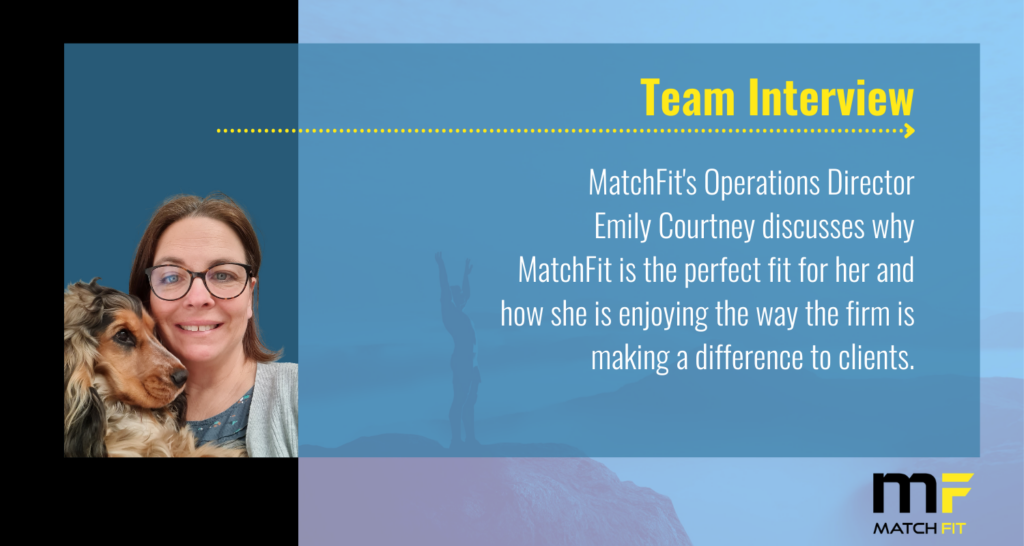
MatchFit Operations Director, Emily Courtney

What were your key roles before joining MatchFit?

I worked for the recruitment company Reed for 15 years. It was here that I first met Bradley, [MatchFit Managing Director, Bradley Honnor], during a contract that Reed Learning was running with a number of Education Departments in several prisons. Most recently I worked as the HR & Operations Director for Reed Learning and had responsibility for the operational delivery of training services and internally for managing the HR function.

For lifestyle reasons, on leaving Reed five years ago, I set up my own consultancy. During this time, I worked with a wide range of firms and projects including most recently a contract with Microsoft and a year working on the Fox/Disney integration.

I kept in touch with Bradley and he approached me to see if I would be interested in working with him at MatchFit. The timing could not have been better, and I have been with the firm since September 2020.

Why did you join MatchFit and what are your key areas of responsibility?

I joined because I was excited by the opportunity and, having known Bradley for so long, knew it would be a good fit. My responsibilities are operational and centred around the delivery of our services. I work closely with the Ministry of Justice team on how we can best deliver our services to client groups based in a number of geographies and with a significant number of staff. On a wider scale I am charged with ensuring we have the right processes and people in place as we grow.

What makes MatchFit stand out from your perspective?

I have always liked variety in a role and I like the breadth of what we do here at MatchFit. The fact that we are working with a client the size of the Ministry of Justice creates challenges, but it is also interesting to work with a client that has so many moving parts and employs so many people. It is a partnership in every sense of the word and exciting to be a part of. As a company we embrace a modern flexible way of working. We access expert help when we need it to support the small nucleus of the business, and all bring different skills.

What have you found most challenging and most rewarding about the role so far?

The biggest challenge is the breadth of opportunity presented by working with a client like the MoJ. The increased use of technology in everything we do is also a challenge given the need to integrate systems with our clients and, of course, the impact of Covid-19 on the delivery of our interventions. In terms of what is most rewarding, it really is the fact that what we do makes a real difference to those who take part and that everyone is enjoying being part of it. It is positive, forward thinking, different and as I said, offers real value.

Have you found any unusual ways to relax in lockdown?

Like many people in lockdown, we have acquired a puppy, Pippa, who is seven months old. I think with everyone being in lockdown pets have become so popular with families who are now spending all their time at home.

Given the restrictions placed on us all, I have never walked my local streets or around my local area as much I have in recent months. The importance of being able to leave the house and get some fresh air has never been as starkly illustrated as it is currently.

In a ‘normal’ world, what’s your favourite thing to do when you have free time?

I know it might sound a little trite but it really is the ability to spend time with friends and family. I miss the simple things like going to a café or the pub with friends at the weekend. Outside of that, the freedom to go swimming, which has always been something I enjoy and have missed during lockdown.

MatchFit Operations Director, Emily Courtney Read More »

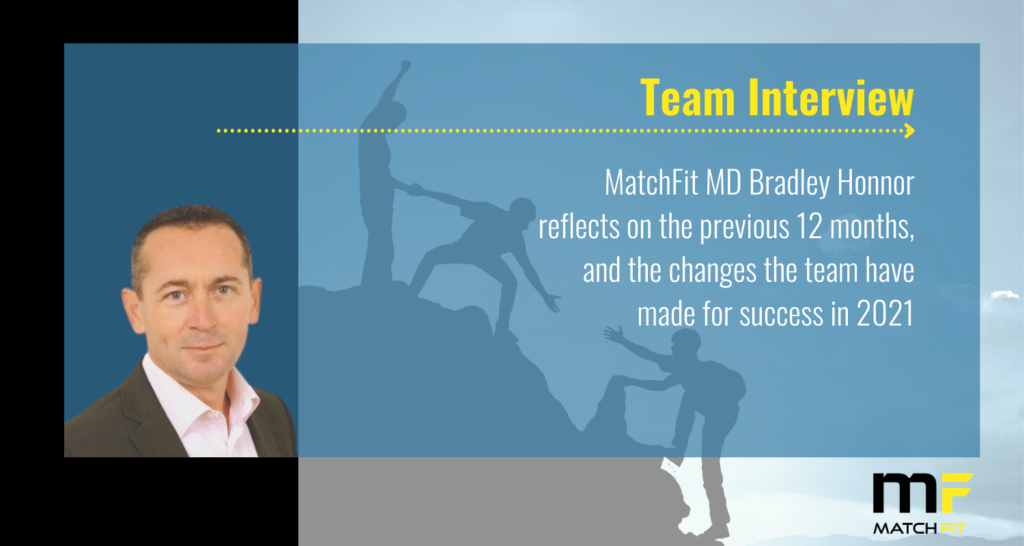
MatchFit and a Pivotal 2020

Bradley Honnor, Managing Director of intervention and talent development company MatchFit, hasn’t always operated in his current line of work. But it’s precisely his diverse background that has allowed him to get a better feel for the human psyche.

“One way or another my background has always been in and around people development, whether that’s physical, mental or emotional health. I’ve always had a passion for looking at a person’s ‘whole health’ which is really where MatchFit’s concept of working with people holistically came from.”

For Bradley and MatchFit, people development is more than just learning to do your job more effectively. With physical, emotional, mental and even spiritual health so intrinsically linked, all aspects need developing for full potential to be realised.

“It’s a concept that always grabbed me”

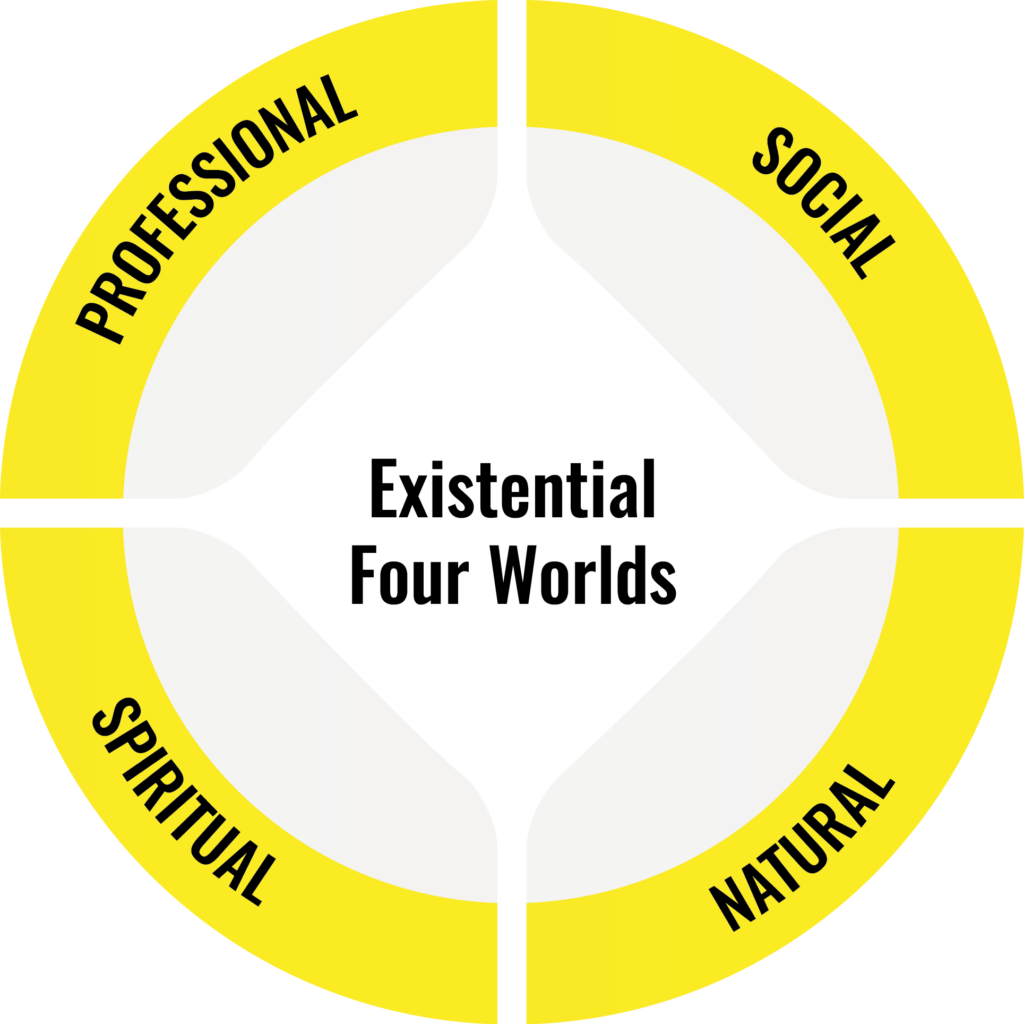
One of the models the team uses is ‘Existential Four Worlds’ – professional, social, natural and spiritual. The model focusses on the notion that it’s not enough for someone to be professionally successful and at the top of their game if their social and intimate world is lacking. If their life is all about work, or socialising or even physical health, they are out of balance and, for many, that’s not success.

“The real definition of success and high performance is someone who has all of those things in balance. That aligns with my counselling and psychotherapy background, and is central to the MatchFit concept.”

When it comes to the question of what MatchFit wants to achieve for clients, the answer is simple: results.

“And those results are defined by the client,” Bradley says.

 MatchFit works with clients from the outset to fully understanding what they are looking to achieve with individuals, teams and the organisation generally. An in-depth analysis of where they are now and where they’re trying to get to is essential if the team is to realise its goals.

Facilitating that journey from where they are now to where they want to be, and doing that in a way that the client recognises the change and can see the results, puts a stamp on those success measures and allows them to say: “This is what we set out to do and this is what we’ve done.”

It’s also about not looking to achieve your goals at all costs

“Employees’ wellbeing needs to be at the centre of everything we do,” according to Bradley. “We’re looking to create a high performing team, and we do that for the long term by creating a healthier and happier team.”

MatchFit works for organisations that buy into the notion of holistic development and are fully committed to making changes.

“We’re not really looking for clients that see staff development as an off-the-shelf or a tick-box exercise. For us to work successfully with an organisation, they need to be reaching above that. Total commitment, right from the very top and through all employee layers, is essential.”

MatchFit works with a range of organisations, from relatively small SMEs right through to large corporates. The Ministry of Justice (MOJ) is one such client.

“We are partnered with the MOJ’s central HR function, which means we’re able to use our expertise as external partners and utilise the teams’ expertise and internal understanding of the MOJ,” Bradley continues.

This is the best of both worlds from MatchFit’s perspective. There’s no guesswork when it comes to understanding culture and the door is open in terms of the time, resources and people-availability to do that exploratory work in a way that’s quite unique.

“Our partnership approach provides the edge to understanding and implementing precisely the right intervention with the staff group you may be working with. People are also more prepared to be open and honest, and talk about their and their organisation’s imperfections, and the challenges they face personally.”

Going forward, this is the type of close working relationship the MatchFit team is looking for in clients.

“Without this close way of working, you remain on the outside and, to a degree, are second-guessing what might be happening on the inside and what interventions are really needed,” Bradley continues. “Clients need to be committed to partnering and following through on what needs to be done, not just be enthusiastic at the start of the process and then lose motivation half way through. It’s really important that we see the programme through to the very end, whilst being prepared to pivot and change the approach when needed.”

Like any business, MatchFit had to think very hard about the impact of Covid-19 and how the pandemic affected their business and the clients they work for.

The reality of putting people’s wellbeing at the centre of everything we do has never been more relevant.

Employees working remotely and being more isolated has thrown up additional challenges for management in terms of changing cultures and bringing teams together.

“We’ve been able to make a huge difference to clients struggling with this challenge and have expanded quite significantly as a result over the last year or so,” says Bradley.

The partnership approach has been a hugely important factor in the team’s ability to make a positive impact during the pandemic, but so too has their ability to pivot quickly to virtual interventions. In normal times, the team’s work is face-to-face in groups or one-to-one, so material and delivery methodology needed adapting to suit virtual delivery.

“We are making as much impact on outcomes as when the work was all face-to-face, so that’s really got us thinking about what’s possible virtually and dropping some of the assumptions that everything we do needs to be in person.”

So whilst the initial fear was that Covid would hit the team’s ability to work effectively with clients, the opposite has been the case and the volume of work has grown substantially.

“I was definitely of the view that to empathise and really engage, the work had to be face-to-face but my perspective has changed completely and, despite all the troubles and worries, 2020 has been a turning point for us as a business” Bradley says.

The team is constantly adapting their model to adapt to changing environments and new opportunities.

“Because our partnership approach has worked so well for clients, we are now looking at how we can engage our customers’ internal resources more effectively. We’re aiming to deliver our methodology, programmes and interventions at greater volume whilst enabling our clients to achieve economies of scale.”

This includes creating three different models of client engagement. These range from a managed service through to the client working almost completely independently of MatchFit, yet utilising their intellectual property and intervention modules alongside a MatchFit quality assurance programme to maintain delivery expectations and quality of service.

“The flexibility to work with clients in different ways is the future for us at MatchFit. We are in a unique position to offer customers proven methodologies and interventions with a model that allows customers to use their own internal delivery resources to make the whole programme more affordable and scalable,” Bradley confirms.

For Bradley and the team at MatchFit, 2020 has been surprisingly positive. By being open to suggestions, embracing technology and the challenges of Covid-19 the business has gone from strength to strength. The future for the company, as they say, is looking bright.


MatchFit and a Pivotal 2020 Read More »