
Bradley Honnor gives his view on how organisations can close the trust gap.
The Edelman Trust Barometer reveals a widening trust gap between leaders and employees. With trust in deficit and a growing credibility crisis in some businesses, this can be a critical risk to organisational success.
According to the Barometer’s latest 2025 report, there is a lack of Trust in top economies: Five of the largest 10 global economies are among the least trusting nations on the Trust Index, including the UK: Japan (the least trusting at 37), Germany (41), UK (43), US (47) and France (48).
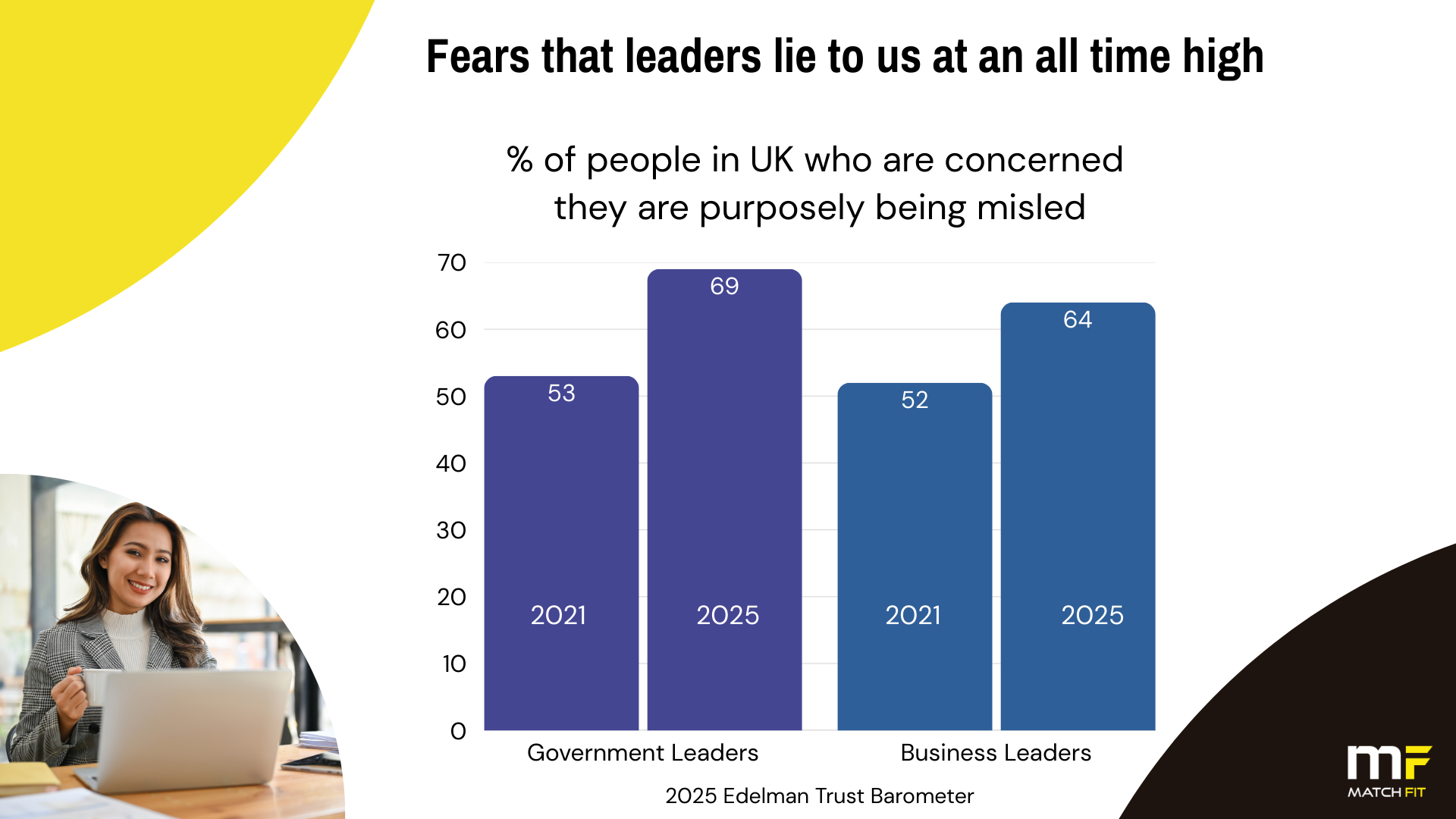
In the UK, national, political and world events including Brexit, Covid-19 Pandemic (including the government’s handling of it) and the invasion of Ukraine have put trust under pressure. Since 2021 the number of people who fear that leaders lie to us is at an all-time high, increasing by 12 percentage points to 64% for business leaders, although somewhat worse for those leaders in government.
In addition, worries about the economy have turned into grievance (frustration and resentment). 6/10 people now feel this way, believing that government and businesses don’t act in their interest and may even cause them harm.
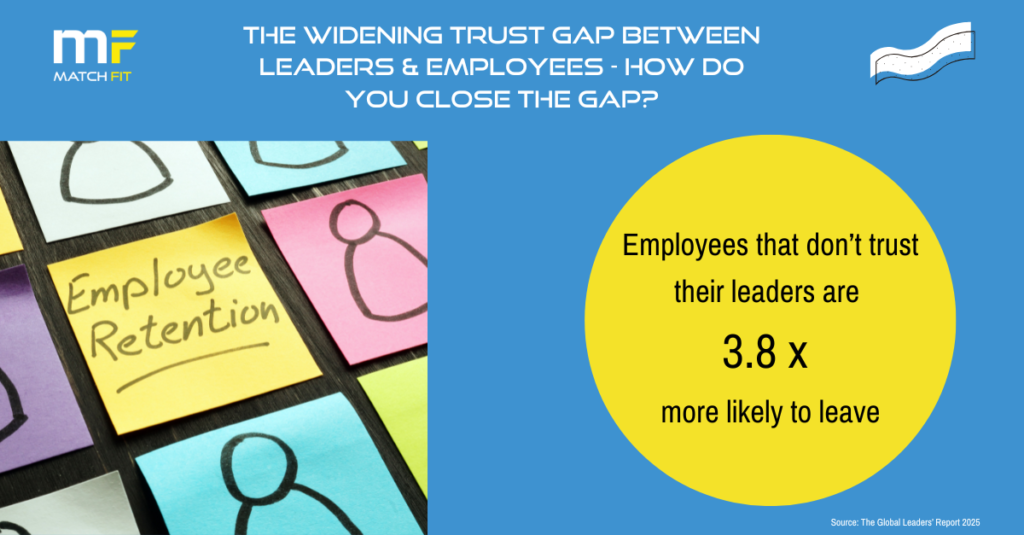
The Global Leaders Report 2024, curated by Development Dimensions International cited that employees are 3.8 times more likely to leave if they don’t trust their senior leaders. To sure-up retention of your top performing employees in order to mitigate the risk of organisational underperformance, increasing the levels of trust between leaders and employees is therefore an imperative.
So, what can business leaders do to counter this lack of trust and mitigate the risk of organisational underperformance?
Whilst I have outlined several approaches below for leaders to counter a lack of trust, we must not forget that trust is a two-way street and that the solution is not just sitting with leadership, but across all levels of the organisation.
Employees also play a role in building a culture of trust, so encouraging participation in mindsets and behaviours where everyone takes accountability and responsibility for their culture at work is a positive step. If there is an issue of trust within your organisation, we might ask ourselves whether there is a developing culture of entitlement that ultimately leaves employees not contributing and through this ‘inaction’ play their role in the creation of a passive and avoidant culture which is low in trust.
Here are my top tips on closing the trust gap and creating stronger trust signals:
- Setting a clear vision, mission and set of values for the business that comes right from the top.
- Every leader and manager models the company’s values, cascading down to every employee. People trust leaders whose actions match organisational values but being authentic and transparent as a leader is wholly important too.
- Rewarding behaviours that align with values.
- Equip leaders and managers to create an environment where everyone is confident to speak up in an atmosphere of trust and transparency.
- Increase transparency through consistent communication.
- Hold regular town halls, Q&A sessions, and team updates.
- Share both good and bad news as employees trust honesty over perfection.
- Explain the ‘why’ behind decisions, not just the ‘what.’
- Employees also play a role in building a culture of trust, its not all up to leadership.
- Employees provide feedback, demonstrate personal accountability and engage in peer support.
- Achieve an upward mechanism for upward feedback, and employee –led initiatives that empower staff.
- Train leaders in human-centred communication. Trust rises sharply, when employees feel they are being listened to. Develop:
- Active listening skills.
- Ability to resolve conflict.
- Emotionally intelligent leadership communication skills.
- Running effective 1:1s.
- Make leaders visible and accessible. Reduces perceived hierarchy and signals ‘we’re in this together’.
- Regular walk-arounds and specific open-door hours.
- Leaders should attend team meetings, not just their own SLT meetings.
- Create leadership accountability for culture. People trust leaders whose actions match organisational values.
- Include trust, engagement, and psychological safety metrics in leadership KPIs.
- Reward behaviours that build trust, not just business outcomes.
- Demonstrate reliability by following through on commitments. When employees see leaders keep their promises, trust can flourish.
- Track commitments.
- Report back on progress (and be honest about delays).
- Where possible, involve employees in decisions that affect them, so they don’t feel ‘done to’. People trust what they have helped to create.
- Run listening groups and co-create the sessions.
- Pilot changes before imposing them.
- Build transparent and fair performance practices. Perceived fairness is a key driver of trust. Include:
- Clear role expectations and progression frameworks.
- Consistent criteria for promotions and pay.
- Bias-aware review processes.
- Recognise contributions and success, frequently and in a meaningful way.
- Give regular praise both publicly and privately.
- Celebrate business collaboration and team wins.
- Raise the visibility of and boost career development opportunities and mobility. Employees trust businesses that invest in their futures careers.
- Develop clear progression paths for employees as part of the appraisal process.
- Demonstrate visible investment in employee development and skills training programmes.
- Demonstrate empathy during change or uncertainty. Empathy reduces fear and increases trust.
- Encourage wellbeing conversations.
- Acknowledge employee challenges or fears openly and offer support and flexibility where possible.
Contact bradley@matchfitclimb.com if you would like to know more about how our programmes can help embed trust within organisations.
Sources:
- About the Edelman Trust Barometer
The 2025 Edelman Trust Barometer is the firm’s 25th annual trust survey. The research was produced by the Edelman Trust Institute and consists of 30-minute online interviews conducted between October 25 and November 16, 2024. The 2025 Edelman Trust Barometer surveyed more than 33,000 respondents across 28 countries. Published every January, the report covers a range of timely and important societal indicators of trust among business, media, government and NGOs, shaping conversation and setting the agenda for the year ahead. For more information, visit https://www.edelman.com/trust-barometer
- The Global Leaders’ Report, Development Dimensions International global-leadership-forecast-2025-report.pdf