bradleyhonnor

Delivering impact through partnership: the MOJ HR Technical Consultancy and MatchFit story

Background

David Wade, Head of HR Technical Consultancy Service at – MOJ Civil Service HR Casework, talks about the partnership with MatchFit over the last five years, and how this has helped his department deliver a more holistic service to clients.

“I’m responsible for a team that delivers HR services to a large number of government departments and agencies,” said David. “The partnership with MatchFit was born out of a number of challenges the HR Casework team had observed, and it helped to fill what was a gap in the wider HR Offer to the Civil Service departments we work with.”

Civil Service HR Casework often worked with departments to support and build capability of line management through what he describes as generic leadership programmes and training. However, there were limitations to what was readily offered to address issues in a very targeted way, particularly around people management and employee relations. And it was from this need that the partnership came about.

From an HR Casework perspective, there was an increasing need for a partner that could bring a slightly different perspective; the ability to build leadership and line management capability.

“MatchFit have offered a point of difference for us, that independent voice able to offer another perspective and help us engage with clients in a slightly different way,” continued David. “And it’s been particularly successful. The mix of HR, employment law experience and Civil Service knowledge from our side coupled with leadership consultants with experience from different industries allows us to provide a tailored service for each client, which is really beneficial.”

Throughout the partnership, MatchFit spent time understanding the environment they are working in. This is particularly important from David’s perspective, especially as many Civil Service organisations they are working with—including the Prison Service, Cabinet Office and DEFRA—have unique environments and want to work with people that understand them.

“That’s something we pride ourselves on as a Casework team, and it’s also naturally important to MatchFit. They spend lots of time building client relationships and understanding the environment and the people to ensure they get the best out of the programmes. And that, I think, ultimately is one of the reasons why the MatchFit service is so positively received,” said David.

A positive and tangible impact on clients

“The feeling from both the Civil Service HR Casework team and MatchFit is that the joint approach is hugely valued,” said David. “And the work generates high levels of engagement from individuals and teams, including leadership teams who traditionally may not always engage in that type of activity so positively.”

Having the Casework side of the partnership also offer a more detailed insight into the workings of Civil Service departments allows the partnership to tailor its approach even further.

“The approach gives individuals a voice that they might not have felt they had previously, especially with the Civil Service often considered quite process-driven and procedural in its nature. And that opens up a new way of thinking with participants challenging themselves more than they had been doing previously,” continued David.

The MatchFit Consultants have worked across many different industries, whether in the Civil Service or the private sector and have been able to bring different experience and ways of thinking to the leadership teams across the Civil Service.

“One thing MatchFit does really well is identify the right consultant for the right group of leaders,” said David. “It’s definitely not a case of one size fits all. It’s very much about trying to tailor the approach that we offer, and that extends through the whole partnership for both Casework and MatchFit. That is hugely important.”

Impact in numbers

A significant focus of the partnership is measuring the impact of the work at every stage so that the impact is clear to every stakeholder.

In all, the partnership has worked with 12 Government Departments and 69 Business Areas.

60 CLIMB programmes with senior leadership teams and 600+ management workshops have been delivered.

Across all departments, the impact has been significant:

  • 99% of survey respondents reported that the management workshops are a positive experience
  • 97% would recommend the management workshops to a colleague
  • 85% of survey respondents increased in confidence following the management workshops by an average of 34%

Across HM Prison and Probation Service, the results have been even stronger:

  • 97% of survey respondents would recommend the CLIMB Programme to a colleague
  • 96% felt the CLIMB Programme has had a positive impact
  • 100% felt that MatchFit Consultant understood the business areas unique challenges.

On average and over the course of the HR Technical Consultancy Service the business areas worked with reported an:

  • 8% positive increase in their perception of Culture
  • 2% positive increase in their perception of My Manager
  • 6% positive increase in their perception of My Team
  • 6% positive increase in their perception of Senior Leadership
  • 6% positive increase in their perception of HR Management

“One of the observations at the very start, pre the work with MatchFit, was that interventions of this nature were often not measured,” said David. “There would be an issue, we would deploy a solution but there was no real measurement against the impact of that solution, both in the immediate aftermath and also over a sustained period of time.”

That was something the team were acutely aware of and wanted to address – to measure the impact of the service they deliver on both managers and leadership teams they work with.

“We want to assess the reaction to the work we are doing – the behaviour change, the learning and ultimately the result. Having a tangible, quite simple, evaluation model really lends itself to that,” David continued.

Installing a measurement process means the team can continue to challenge itself and help the clients hold themselves to account. It is now possible to understand the progress groups are making and engaged in, and that could be used to keep them engaged and motivated.

“That’s important, because often you do this type of work and focus on the next day and the day after that but lose sight of the overall progress that’s being made,” said David. “And measurement allowed us to look at that progress.”

Measurement also helps the partnership to demonstrate a return on investment in the work that that clients are ultimately funding.

The team utilises quantitative metrics to understand progress. Surveys are undertaken both at the start and end of programmes to see the shift in team leadership culture and HR people management within the groups. This provides a helpful metric to understand progress, but also gaps that still need to be addressed. Metrics are collected around issues such as how confidence has increased and average working days lost  to understand how individuals, managers and leaders, were engaging with the HR aspects of their role.

“We are able to track these over a sustained period of time, even beyond the conclusion of the programme,” David said. “So we get a feel for how the work we do has a sustained impact beyond just the time we spend with clients. And we’ve seen really positive results across the board in regards to that sustained impact for the departments.”

Clients are provided with structured reporting packs, both at the initial Analysis Stage, throughout and post programme. The means that senior leaders receive dashboards following every intervention delivered to their management team, and also following each client group session with their senior leadership team.

“So over the course of the programme, they receive tangible output that they could utilise day to day. And then at the end of the programme, they receive a report that shows them where they started, what they’ve done and where they are going,” said David. “It’s as much about outlining the successes as it is highlighting the focus areas for clients. So yes, the programmes are both tailored and very well structured in terms of delivery and evaluation, which means that all parties really know where they stand.”

“Overall it’s been a great partnership that has strongly benefitted the a range of departments and agencies within the Civil Service,” concluded David.

If you’d like to learn more about our MatchFit leadership programmes, take a look at our information pages here, or why not get in touch? enquiries@matchfitclimb.com

Delivering impact through partnership: the MOJ HR Technical Consultancy and MatchFit story Read More »

Making a measurable impact within a mid-sized financial services firm

Background

Having helped and supported the leadership team to become more effective and more impactful as managers to the wider staff group in this mid-sized financial services firm [Supporting transformative SLT change at a mid-sized financial services organisation], MatchFit continued its work, this time with lower-management grades and specific teams.

Empowerment

The Head of Operations, picks up the story.

“Tim [a MatchFit consultant] was very good at using models that resonate with us as a team and office. One of them was about ‘moving the decision to where the information lies’,” she said.

This and other interventions have helped shift the thinking within the organisation towards empowerment where managers at all grades now have the confidence to make decisions without any fear of repercussion.

“Not only that,” said the operations head, “But they can feel supported by the SLT in those decisions.”

And that’s been transformational, because not everything has to come up through the different hierarchies into the SLT to then make the decisions. This has created a safe space where people feel supported and are helped to make informed decisions, which has made an immense impact to the whole organisation.

Developing the next level of talent

One of the most beneficial pieces of MatchFit’s work was the CLIMB Shadow ExCo Programme, an immersive and interactive programme that develops future leaders and engages talent to deeply understand how leadership should work within an organisation.

“It was just the most brilliant opportunity for a cohort of individuals across the office to be engaged in.

At the time, an organisation-wide staff survey wasn’t as positive as it should have been for a number of themes but the Shadow ExCo was an opportunity to pick up on some of the key areas with the survey and build a programme to address them.

“Via the Shadow ExCo, we were able to undertake projects around innovation, around what makes a good manager, around engagement, around induction, around managing a quality service, and run those projects throughout the course of the programme with those who were on the cohort at the time,” she continued.

The 12-month programme had a hugely positive impact on both the cohort and the wider business too.

Improving the staff survey scores

“We were keen to see how the 2024 people survey results would differ from those in the previous year and to see the benefit from all the work, including the Shadow ExCo programme,” she explained.

The results were unprecedented.

“For the first time ever we’ve seen a positive increase across all our core themes, and it is evident that the work MatchFit has done, the programmes they have run, their interventions have all come through beautifully in our staff survey results,” the Head of Operations continued.

A score related to how people perceived their manager for instance, increased significantly by 11 positive percentage points. This is a huge number which the operations head put down, in part, to the Shadow ExCo programme which helped equip managers with the tools and skills they need to improve their managerial ability.

Other interventions like those relating to having difficult conversations and what a good conversation looks like, again helped to improve scores. Another really positive score was around L&D, which saw a positive percentage increase of 14%.

“That is off-the-scale massive. And again, it’s all the development opportunities we’ve been able to afford for our staff over the past 12 months both internally and with MatchFit’s help which means staff feel more invested in, valued and listened to.” she continued.

One change that the operations head describes as ‘music to my ears’, was the leadership and managing change theme, which saw a huge positive increase of 14%.

“Again, I think it was absolutely as a result of MatchFit doing all that transformational work with the leadership team, and also all their engagement work with the Shadow ExCo programme,” she said.

The work has helped colleagues increase their perception of the SLT in terms of transparency around decision making.

Improving engagement across the organisation

One of the projects on the Shadow ExCo programme was engagement, an important theme for the organisation.

“As a result of what we did with MatchFit, engagement is at the heart of everything we do now. It sounds so simple, and you might ask why wasn’t it at the heart of everything that we did previously. But we were just stuck in that rut of we’ve got our jobs to do. We’re so busy, we haven’t got enough resources, we just need to get through the day-to-day work. That makes it easy to forget that the softer side of what we do is so important. MatchFit really opened our eyes to that,” she said.

Because of the specific engagement work in the Shadow ExCo programme, the organisation now has two engagement champions who regularly work with the senior leadership team to feedback on issues that have arisen and also successes that colleagues want to be fed back to the SLT. A ‘Colleague’s Voice Committee’ has been formed and meets every couple of months.

“We have success boards. We have a new intranet now, which is a one-stop-shop for all our information needs. So it’s really facilitating more regular interaction amongst the senior leadership team with a whole host of people across the organisation. Again, it sounds really, really simple, but it has such a transformational impact on us as a whole,” she continues.

Overall, it has been a lot of hard work to get the organisation to where it is now. But the collaborative joint effort with MatchFit and the opportunity to recognise and address challenges has shone through in the people survey results and benefitted the entire team and business in a positive way.

If you’d like to learn more about our MatchFit leadership programmes, take a look at our information pages here, or why not get in touch? enquiries@matchfitclimb.com
Making a measurable impact within a mid-sized financial services firm Read More »

Supporting transformative Senior Leadership Team change at a mid-sized financial services organisation

Background

In 2024, a mid-sized financial services firm commissioned MatchFit to support with improving the effectiveness of the organisation in line with a new leadership vision. Their Head of Operations, someone who has been heavily involved with MatchFit’s work, was kind enough to discuss the impact of MatchFit’s interventions and, in particular, their senior leadership team who were tasked with implementing the new vision.

CLIMB Programme

“Their [MatchFit] CLIMB programme has had a transformational effect on the SLT group,” said the operations head, who has leadership oversight of three main divisions within the company.

As an organisation, they needed new impetus and, with a new leader looking to put their people at the heart of everything they do, a huge cultural shift was needed to make that work. For the new philosophy to be effective and to embed the change, the organisation needed to start from the top and create a cohesive, forward-looking and modern senior-leadership team.

“And for me, that has been the biggest contribution from MatchFit,” said the Head of Operations.

MatchFit Consultants

Tim Forman [a MatchFit consultant] began working with the SLT at a time where the makeup of the team wasn’t gelling as well as it needed to. Colleagues were coming at the challenges facing the organisation from different angles and there was a lack cohesive direction. As a result, the effectiveness of the team wasn’t where it needed to be and this was affecting the performance of the entire organisation.

“Tim really worked hard with the SLT to bridge and create a more collaborative team moving forward, and importantly I think, to ensure that we all felt valued, and that all opinions mattered, no matter how different,” continued the Head of Operations.

MatchFit worked with the SLT both individually and as a group, initially to really get to the bottom of what issues needed to be addressed.

“We hadn’t had that type of intervention before. We hadn’t had that critical eye from outside of the office. Having those independent insights of us individually but also as a collective, was really, really important. We began to value our differences and our different perspectives which, in turn, made us more effective as an SLT,” she said.

With the help of MatchFit, the SLT worked on setting clear priorities and plans for the future.

“That sounds really simple, but we hadn’t actually done before in a structured way,” she continued.

The team was encouraged to step outside of their individual roles and put on their SLT hats at appropriate times. This meant not always firefighting around individual roles or teams but looking at issues from an office-wide perspective.

Transformative Impact

It made a transformative impact according to the Head of Operations: “The programme very quickly made us positively question what we wanted to achieve as an SLT and how we would work to collaboratively set goals. There was a real shift in dynamics, from it being, multiple camps feeding into the SLT, to being that one voice and that voice feeding through to the entire office.”

This created a positive shift in the office towards the SLT and its purpose and enabled them to establish a more robust governance structure and accept empowerment as key to shaping their structure. With the team setting a clearer vision and goals and communicating them effectively, there is now much more respect from the wider office in terms of what senior leadership team does and the vital role it plays in driving the organisation forward.

If you’d like to learn more about our MatchFit leadership programmes, take a look at our information pages here, or why not get in touch? enquiries@matchfitclimb.com
Supporting transformative Senior Leadership Team change at a mid-sized financial services organisation Read More »

How tailored training and development drives success

Article 1: How tailored training and development drives success

Welcome to the first of a series of articles based on a recent OxTalks podcast in which Chris Oxley (Managing Director, Oxley & Partners) and Bradley Honnor (MatchFit Managing Director) discuss leadership and development training.

In this first episode, Bradley explains the light bulb moment when he realised the potential for reimagining personal development training and created MatchFit to deliver his vision.

Frustrated by the ‘sheep dip’ approach as described by Chris Oxley, Bradley set out to build an approach that is self-directed, highly relevant and outcome focussed.

You can read the transcript of their conversation below. Click the link at the end of the transcript to listen to the full podcast.

Transcript

Bradley: I really thought about what it is that interests me professionally. Throughout the work I’ve undertaken for all of my career, I’ve always been in that people development space, in a variety of ways. I’ve worked as a sports massage therapist and a psychotherapist. And what I found is that people have an innate interest in thinking about how they can improve their life, their experience of life, their experience of work/life.

So working within learning development or organisational development for many years, I started to be quite critical of the development methodology that was on offer. Quite often there’s a process that’s unmeasured or lacking in relevance for the individuals taking part. You might engage in a leadership program where some of it is very relevant, but you’re there for four or five days. Some you’ve done before. Some of it’s not so relevant because you’ve got a field team, for example, and you’re more interested in how best to manage them remotely and the course doesn’t cover that.

I started to think about Richard Branson. Not that I’m comparing myself, but I love the fact that he looks at a service and asks himself how could he do it better. So I was thinking that surely there must be a better methodology to deliver learning and development experiences for individuals and teams. And because of my psychotherapy training, I was very familiar with the concept of phenomenological interventions and, for me, that seemed like a much better way forward. So I took the step from leaving an employed role and moved into going it alone and seeing how people felt about what I was offering as an alternative approach.

Chris: You touched on the ‘phenomenological’ approach. Can you explain that a bit more?

Bradley: It’s about understanding that every individual is completely unique. And, for those listening, that won’t be a great surprise. But what is surprising is that we don’t always treat individuals as individuals. We tend to group people together and assume the content is going to be relevant for leaders, rather than looking at that specific leader in that specific context of where and how they are working currently. And from here, really starting to think about, what does that individual need in terms of their development.

The starting point of that phenomenological approach is to really engage with them and to see what it is they want to work on or want to look at, and then shape the interventions and approach to their development around that input. So it’s very specific and very relevant. It’s very behavioural. Leaders drive change, but behaviours drive leaders.

So what are the behaviours that will help this leader engage in a development activity? What are the behaviours that they’re looking to address themselves? And then it’s about shaping the content and approach specifically around those challenges. And that way we get great buy in. Individuals are really engaged because they’re shaping the development experience themselves. We’re facilitating and steering that, but the direction comes from them. It’s a self-directed experiential learning process. And I’ve found, through delivering our services in that way, that people get a great deal of value, because there’s no generalisation of what a good leader should be.

Chris: It seems like you’re involving the people you’re supporting in developing their own journeys. Is that, right?

Bradley: Very much so. I’m the first to stand back and say: I don’t know until at least we speak and really engage together, what you need, what your interests are, what’s going to spark that fire, what’s going to capture your interest. And a way to really do that is analyse the team or individual or organisation, and to start looking at what people are talking or thinking about, and where they feel their challenges are. And then we can present those things back to that individual, team or organisation so they have an independent view of the issues.

If we are working with a leader, we can talk to them about what they feel they need to address. And there will be a number of directions that we can go in, a number of priorities we could approach. But in their minds, in their context, in the environment in which they are working, they will know what’s most important. And by the very definition of that conversation, that individual or team or organisation is engaged, because they know they’re setting the scenes themselves. They’re setting up the context to those conversations, rather than us coming in and imposing some external, irrelevant, content on them.

For me, a fundamental aspect of what we do is to do the listening before we design and deliver the intervention.

Chris: I’m presuming you’ve seen quite an increase in engagement from that sheep dip approach, and I’ve noticed that, through certain L&D individuals I’ve spoken to, they’re almost fed up with the constant one size fits all. There seems to be a real need now to find something that’s more individual to inspire teams. Christian hunt, who I know, was UBS’s first Managing Director of Behavioural Science, but he come from a compliance background, and was using behavioural science to lead people to be more compliant to rules. It’s looking at those types of strategies, and it feels like there’s some similarities here. Is that, right?

Bradley: Very much so. We’re working with very senior people generally. An organisation we’re working with right now has a £4 billion turnover and are in every country you can imagine. They have an end-to-end service, everything from design to logistics and digital marketing.

They’re very sophisticated, experienced people, and have done a lot of traditional leadership work. But what they want is something that’s much more personalised and relevant to them. And quite often we find those leaders will have exceptional business acumen so there’s a limit to what we can teach them about leading a business. But as soon as we get into the behavioural psychology of what we do, people find that quite fascinating. How could I find more motivation in myself? How do I motivate and engage my team? How do we find a sense of purpose and drive a vision? We find that behavioural science gives what we do validity.

People can see there’s science behind what we’re doing. Because engaging and leading people is a fine line between art and science. There’s a real art to that. There are some nebulous things we need to be doing, understanding and putting into practice to lead effectively. But there is also science behind behaviour and the way we think and operate. So shedding light on the components of performance psychology, and how leaders apply them in their role as a leader, we find is a much more interesting and relevant conversation for these very experienced and senior people.

We hope that you enjoyed this conversation and remember look out for Episode 2 soon. You can listen to the whole conversation here The Transformative Impact of Personalised Development with Bradley Honnor

If you’d like to learn more about our MatchFit leadership programmes, take a look at our information pages here, or why not get in touch? enquiries@matchfitclimb.com

How tailored training and development drives success Read More »

Why it’s essential for people-development consultancies and HR teams to work together

The background to the partnership between MatchFit and the Ministry of Justice

For the last five years MatchFit has worked in partnership with the Civil Service HR Casework Team. The teams’ close working relationship has been a major driver behind the successful impact of this partnership with Civil Service clients.

We sat down with Finola Neligan, an HR Technical Consultant within the MOJ who has worked closely with MatchFit consultants over several years to get her view of the partnership.

“I am an HR Technical Consultant, sitting within the HR Casework Team,” says Finola. “Our overarching aim is to upskill and improve the outcomes line managers across the Civil Service can achieve in the course of their people management. My role specifically is to work with business areas across the Civil Service, not only within my department, but others as well, to support them when it comes to challenges such as performance, sickness management or cultural concerns. I then support them to achieve positive outcomes and they upskill in the process.”

Finola was first introduced to MatchFit when they worked with her team internally, providing internal L&D support including one-to-one coaching. From there, a formal partnership was created to deliver a service for clients (other departments and agencies) across the Civil Service. It was at that stage that Finola moved into the role of HR Technical Consultant to work within the framework of the partnership.

Setting high performance goals

The partnership’s aim, and the work undertaken with numerous clients over the years, was to enable and support sustainable high performance in Government departments and the teams within. The activity has been instrumental in improving not only culture, but also the performance of business units.

“We worked closely with MatchFit to create a programme of analysis and delivery that helps to support not only leadership teams, but also management teams within these business areas,” continued Finola. “The purpose of the analysis is to explore line management capability and the employee experience, identifying what is working well and where the challenges may lie. Coming from an HR background I have access to the rich HR data in relation to those business areas and can bring that expertise to the table. We look at the people issues in terms of HR cases— attendance management or performance etc.—and MatchFit comes in to gather and act on the qualitative data around what it’s like to be a member of staff in that business and how that can be improved. It works really well, because we’re able to combine both that quantitative data and HR insights with their qualitative findings, which provides a really robust analysis of what is actually going on in that business unit.”

Why the partnership approach was a key success factor

In terms of the need for a close working relationship with a consultancy like MatchFit and Civil Service HR Casework, Finola was very positive.

“It was pivotal, to be honest,” she says. “We needed to ensure there was constant communication between the two parties, because MatchFit was supporting in relation to the leadership aspect of the teams we were involved with. They would deliver the CLIMB programme, which would include one-to-one sessions and group sessions with the senior leadership team. Working in tandem, we would then deliver a number of training interventions at a management level.”

There was a need to be very clear on the objectives of that work, the analysis findings and how that fed into the work undertaken with staff within the businesses.

“Our constant communication meant that any kind of issue or theme either at the senior leadership level or at the management level, could be fed into both aspects of the programme, so that ultimately we were helping to improve communication in the business,” said Finola. “There needed to be, and was, a synergy to the work we were doing. That would feed into the outcomes towards the end of the programme that we could then present back to the client in terms of our consistent approach at different levels. And this is why it’s been successful.”

For Finola and her colleagues, how joined up they were as a team to capture and deal with issues coming out of the workshops was central to their success.

“If I was delivering a workshop on how to manage performance with a number of line managers and they were talking about concerns around workload, or their ability to make independent and autonomous decisions, we could feed that into the Senior Leadeship Team (SLT). The CLIMB programme provided space for the SLT to reflect on these types of issues and incorporate them into their strategic direction. And that ultimately improves the experience for all employees within the business area, and enable positive change” said Finola.

Why MatchFit?

Asked if she would recommend MatchFit to other clients, Finola was very positive in her response.

“Yes, absolutely. I would recommend them to any business that really wants to get to grips with what’s going on below the surface of their team dynamics,” continued Finola. “Their consultants have rich and varied work experiences and qualifications. They’ve all got specialist areas and it’s really helpful to have that breadth and knowledge. They’ve been able to independently challenge senior leaders across the teams we’ve worked in, which has led to some really positive outcomes. As an organisation, we’ve had a really successful partnership with excellent governance and communication. So absolutely, I’d recommend them, if you are looking after a business area and really want to see how you can start to enable change.”

If you’d like to learn more about our MatchFit leadership programmes, take a look at our information pages here, or why not get in touch? enquiries@matchfitclimb.com
Why it’s essential for people-development consultancies and HR teams to work together Read More »

How mentorship can accelerate leadership growth and organisational success

Mentorship has long been recognised as a powerful tool for personal and professional leadership growth. In the context of leadership development, mentorship takes on even greater significance, offering a unique opportunity to cultivate the skills, insights, and confidence necessary for driving organisational success. By creating and building connections between experienced leaders and emerging talent, mentorship creates an environment of learning, innovation, and collaboration.

While well understood, however, to be a positive people-orientation strategy, many businesses struggle to implement or maintain mentorship programmes. In fact it has been found that 76% of people think mentors are important, but only 37% have one.

A tailored path to leadership development

Leadership is not a one-size-fits-all discipline. Every individual brings a unique set of strengths, challenges, and goals to the table. Mentorship enables a highly personalised approach to leadership development, where mentees can receive tailored advice and guidance that aligns with their specific career trajectory and aspirations.

For instance, through regular one-on-one interactions, mentors can help mentees identify blind spots, refine communication styles, and tackle complex business challenges. This individualised approach accelerates growth by addressing real-time issues while simultaneously building strategic thinking and decision-making capabilities.

Key benefits of mentorship for leadership growth

Mentorship impacts leadership development in several transformative ways:

  1. Enhanced self-awareness: Mentors often act as mirrors, helping mentees understand how their actions and behaviours impact others. This feedback loop builds a greater level of self-awareness, a critical component of effective leadership.
  2. Accelerated skill acquisition: By learning from mentors’ experiences, mentees can acquire essential leadership skills faster, avoiding common pitfalls and focusing on strategies that work.
  3. Confidence building: A mentor’s encouragement and support can significantly boost a mentee’s confidence, enabling them to take calculated risks and embrace leadership opportunities.
  4. Expanded networks: Mentors often introduce mentees to broader professional networks, opening doors to new opportunities and collaborations.

Overall, it has been found that mentorship programmes can advance career development with one study finding that mentees are promoted 5 times more often than those without mentors.

Organisational advantages of mentorship

While mentorship directly benefits individuals, its impact on organisations can be as powerful. One significant advantage is the development of a stronger leadership pipeline. By nurturing talent internally, organisations can prepare a steady stream of capable leaders who are already familiar with the company’s values, culture, and strategic priorities. This reduces the reliance on external hiring for leadership positions and ensures continuity in leadership style and vision.

Additionally, mentorship contributes to higher levels of employee engagement. When employees participate in mentorship programs, they often feel more valued and supported in their professional journeys. This sense of appreciation enhances job satisfaction and loyalty, ultimately leading to lower turnover rates. Organisations with engaged employees are better positioned to maintain morale and achieve their strategic goals.

One study found that retention rates were much higher for mentees (72%) and mentors (69%) than for non-participating employees (49%).

Mentorship also plays a pivotal role in innovation and knowledge sharing. The collaborative nature of mentor-mentee relationships encourages open communication, cross-functional learning, and the exchange of ideas. This culture of continuous learning and collaboration becomes a breeding ground for innovative solutions, helping organisations stay competitive in a rapidly changing business landscape.

Strategies for implementing impactful mentorship programs

To reap the full benefits of mentorship, organisations must take a thoughtful and strategic approach to designing their programs. Here are a few key strategies:

  1. Align mentorship with organisational goals: Effective mentorship programs are not standalone initiatives. They should align with broader organisational objectives, such as developing leadership competencies or enhancing cross-departmental collaboration.
  2. Select the right mentors: The success of a mentorship program hinges on the quality of its mentors. Select individuals who not only excel in their roles but also have the communication skills and empathy needed to guide and inspire others.
  3. Provide structure and resources: While mentorship relationships should be organic, a certain level of structure—such as goal-setting templates or regular check-ins—ensures that both mentors and mentees stay focused and committed.
  4. Measure impact: Use metrics such as employee retention rates, leadership readiness, and mentee satisfaction to evaluate the effectiveness of the mentorship program and make necessary adjustments.

Real-world examples of mentorship success

Case studies across industries highlight the tangible benefits of mentorship. For instance, companies that integrate mentorship into leadership development programs often see increased promotion rates among mentees and greater diversity in leadership roles. MatchFit’s CLIMB Programme, for example, is designed to enhance leadership communication and team dynamics, demonstrating how mentorship can serve as a cornerstone for cultural transformation and high-performance results.

Overcoming common challenges

While mentorship offers numerous benefits, it is not without challenges. Potential pitfalls include mismatched mentor-mentee pairs, a lack of commitment from participants, and unclear expectations.

Organisations can address these issues by creating a robust matching process through the use of tools such as personality assessments or skill-based criteria to pair mentors and mentees effectively.

Training for mentors can also be useful, so they are equipped with the skills they need to provide constructive feedback, handle sensitive topics, and navigate cultural differences.

Setting clear expectations is also key to a successful programme. Define roles, responsibilities, and desired outcomes at the outset and this will help to ensure alignment and accountability.

The ripple effect of mentorship

When mentorship becomes ingrained in an organisation’s culture, the benefits extend far beyond individual participants. A mentoring mindset builds collaboration, inclusivity, and a shared commitment to excellence. By investing in mentorship, organisations build a resilient foundation for sustained success.

If you’d like to learn more about our MatchFit leadership programmes, take a look at our information pages here, or why not get in touch? enquiries@matchfitclimb.com

How mentorship can accelerate leadership growth and organisational success Read More »

person climbing sheer rockface on left, looking out at hot air balloon floating in blue sky with wispy white clouds

“Motivation is the fuel that drives us forward.  Moving forward drives our motivation.” Part I – Self-motivation

The continuous loop of motivation is a powerful driver for success and achievement once you and your team are in its flow. But if a lack of motivation is the challenge you’re tackling, what steps can you take to build motivation in yourself, and others? In this first of a two-part series, we look at self-motivation.

The use of the word motivation can be traced back to its German form in 1854. Originally, it was considered a singular determinant of human thoughts, feelings, and actions. However, it was soon apparent that motivation operates with other determinants as well, such as cognition, affect, habits.

But if we agree that motivation is a critical factor in the success of the individual and team, how do we actually address the challenge when it is clearly lacking?

Understanding what it is

First of all, it’s important to recognise that self-motivation and motivating others are two separate areas, which each require focus and dedication. And then we need to understand the factors that determine why motivation might be inherent in some individuals, but not in others. Much research has been published, and books written about the topic – indeed, Motivational Theory is a subject area that could keep you occupied for weeks, if not months!

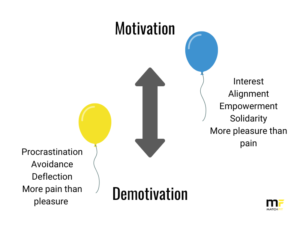
In some circumstances, people are motivated because of an alignment with their interests, or their natural inclination towards certain goals, such as succeeding in their career. Equally powerful though, is the motivation to distance ourselves from something unenjoyable or unpleasant – for instance, the company culture that becomes so unbearable that the only option is to leave. Generally, we’re motivated either towards, or away from something.

One of the reasons our CLIMB programme works so well is that it aligns group motivation towards an agreed team goal while recognising that individual goals can be personal, and quite different from each other. Within the CLIMB analogy, some will be motivated to get to the summit, whilst others are content with reaching basecamp. Both will contribute to a successful team, as long as their motivations are understood, accepted and feed into the ultimate goal.

Environment and culture obviously has a significant influence. If we work in an organisation where we’re supported, listened to, respected and valued, we’re far more likely to feel motivated, and in turn, be more inclined to embrace the goals we’re set. When the opposite is true, our leaders are likely to meet more resistance.

But, assuming we’re not at those extremes, how do we motivate ourselves in an area that’s maybe not a natural inclination for us, but is important for us in terms of our performance? At MatchFit, we use the phrase ‘wishing, hoping or really wanting to’ to drill down into how much of a priority someone has really assigned to a task or goal. Sometimes, it’s about the pain-pleasure principle – finding that point where the pain of not doing something is worse than just getting it done. And that will be part of the phenomenological experience, different for everyone.

High performance, then, is about deciding where you need to be motivated in order to improve your performance, whether you feel motivated in those areas or not. How do you flick that switch?

Making motivation a strategy

A common mistake is not making motivation a strategy. It’s almost as if there’s an expectation that you’re either going to be motivated or not, and it’s other people’s responsibility, especially in the work environment, to make sure you’re motivated. But, outside of the sports industry, where motivation is a such a key driver for performance, you don’t often hear about the need to make self-motivation deliberate. Like any skill we want to learn, or behaviour we want to adopt, we need to develop motivation as a habit, a discipline in itself to be nurtured and grown, in order to develop and maintain the thinking, behaviours and attitudes that support our goals, wherever they are. Athletes achieve this by a combination of focusing on marginal gains, breaking goals down into smaller elements, and developing consequential thinking – looking at what they will lose if they don’t do that thing they don’t really want to do, and what they will gain if they do.

Motivating ourselves when we’re stuck

Sometimes, for example, we have to accept that while we’re in a job we don’t enjoy, the risk of leaving is greater. In that circumstance, how do you develop the skill set or exercise that muscle that actually makes you motivated to do well or enjoy that job more?

Recognising that while you might not be able to leave right now, you can choose to leave at some point in the future, is helpful. You can look at the individual aspects of the job – recognise what’s not so bad, even if it’s not enjoyable. Maybe you’ve got some autonomy, or once your job’s finished at five o’clock you can go home. Maybe you don’t have far to travel and your colleagues are nice people. You can shift your mindset from ‘I hate my job’ to accepting that it’s not forever and planning an exit strategy – what you can do today, right now, every day that moves you towards that goal.

Habits for improving self-motivation

  • Make motivation a strategy
  • Decide are you wishing, hoping or really wanting?
  • Develop consequential thinking
  • Define aligned goals
  • Develop a pre-game routine to get started (we like this blog from James Clear) )

In part II, we’ll look at how we can inspire others to find and maintain their motivation, especially during challenging times.

Read Part II here

“Motivation is the fuel that drives us forward.  Moving forward drives our motivation.” Part I – Self-motivation Read More »