
This article was updated in May 2026 to reflect new trends and insights.
Research has shown that the proportion of workers aged 55 and older is projected to reach nearly 25% of the workforce in G7 countries by 2031, reflecting a significant rise in age diversity in the workplace.
As people remain in the workforce longer, today’s organisations are increasingly composed of age-diverse teams. Employees in their 20s now collaborate daily with colleagues in their 60s and beyond. This shift brings new levels of diversity in values, expectations, and attitudes toward work, but also poses a challenge for managers – how to lead in a way that uses this age diversity for high performance rather than letting it create division.
The key to effective management lies in understanding the lived experiences of team members and using that insight to shape leadership, communication, and culture strategies. A tailored, reflective approach like MatchFit’s phenomenological methodology can help managers work through this terrain effectively.
Understanding generational differences
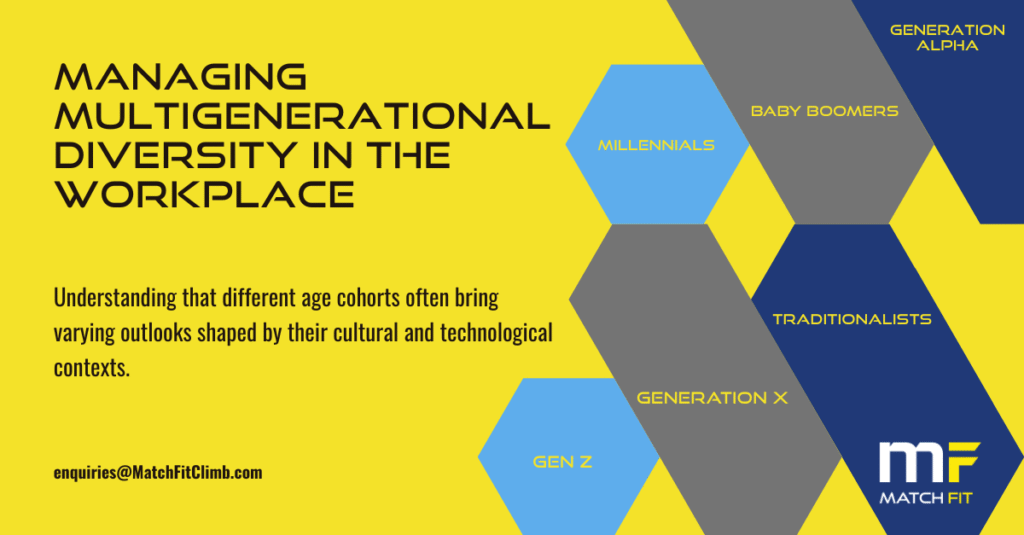
Managing age diversity in the workplace means understanding that different age cohorts often bring varying outlooks shaped by their cultural and technological contexts:
- Baby boomers – may prioritise loyalty, hierarchy, and job security.
- Generation X – values independence, flexibility, and pragmatism.
- Millennials – tend to seek purpose, feedback, and work-life balance.
- Gen Z – is digital-native, values inclusivity, and thrives on rapid growth opportunities.
A 2023 Pew Research Center study found that Millennials and Gen Z are significantly more likely to value diversity and flexibility at work, while Baby Boomers and Gen X place higher importance on job security and structured communication. These are, of course, generalisations but they highlight why a one-size-fits-all approach to management is no longer viable.
Moving from awareness to alignment – bridging the generational divide
Awareness of these differences is a start, but sustainable high performance comes from alignment. MatchFit’s CLIMB to Align programme addresses this directly, helping leadership and management develop strategies that support intergenerational collaboration. A Harvard Business Review analysis found that companies with strong intergenerational collaboration practices reported 10% higher employee engagement and 5% higher productivity than those without such practices.
A multi-generational workplace can bring significant advantages to organisations. More experienced Gen X and Millennials can contribute valuable insight, mentorship, and organisational knowledge, while Gen Z employees often introduce fresh thinking and digital expertise. Diverse teams offer a broader range of perspectives and experiences, driving stronger innovation and more creative problem-solving.
By engaging in open dialogue and co-creating plans that respect differing values, work styles and learning, managers can bridge the generational divide and manage age diversity in the workplace more effectively.
Coaching across generations
Developing strong coaching skills is essential in this environment, especially as Millennials who now account for nearly 40% of the working population prefer a coaching leadership approach.
Reverse mentoring can also be beneficial; pairing younger employees with older colleagues in mentorship relationships where both parties learn from each other. Younger employees bring digital fluency, knowledge of emerging technology, communication and collaboration tools, and insights into changing customer and workforce expectations, while older employees can share industry and organisational insights and professional experiences.
MatchFit’s WeCLIMB Coach module equips managers to adopt a coaching mindset, one that replaces assumption with curiosity. Coaching encourages managers to ask, “What motivates you?” rather than assuming what worked for them will work for everyone.
This coaching approach enables managers to unlock individual potential, irrespective of age. It also strengthens psychological safety by showing that diverse perspectives are not just accepted but valued.
Building self-awareness and adaptive leadership
Managers need to be attuned not only to others’ differences but also to their own leadership tendencies. Increasing self-awareness helps leaders understand their own motivational drivers and behavioural patterns. This reflection is the foundation for adaptive leadership, adjusting one’s style to fit the needs of the team.
Communication preferences can also be a challenge. For example, a manager who tends to value face-to-face interaction might need to stretch to accommodate younger colleagues who are more comfortable with asynchronous digital communication. Conversely, younger managers may need to learn how to build rapport and trust with older colleagues who prefer more structured communication.
Creating shared purpose through culture
A unifying purpose can transcend generational differences and help to manage age diversity in the workplace. A focus on culture transformation is critical here. By engaging the entire organisation in a discovery phase, including one-to-one interviews and staff surveys, it is possible to uncover the cultural nuances that influence team dynamics.
From these insights, tailored interventions can be deployed to realign the culture with business priorities. A Deloitte Global Human Capital Trends report found that organisations with a strong sense of shared purpose and inclusive culture are significantly more likely to have high-performing teams, regardless of generational makeup.
Millennials, who now make up a significant proportion of the mid-career workforce and are often in leadership roles, place great importance on team alignment with a sense of purpose.
When employees of all ages see how their work contributes to a larger goal, they are more likely to engage and perform—despite their differing personal expectations.
Embedding continuous learning and feedback
One shared trait across all generations is the desire for growth, though how they experience it may differ. Regular feedback, coaching conversations, and opportunities to contribute to strategic initiatives can keep all team members engaged and growing.
Measuring what matters
A multigenerational team can only thrive if progress is measurable. Interventions need to evaluate success on a number of levels, including initial reactions, new understandings of team members, behavioural changes, and ultimate results for the team or business. This ensures that managers not only implement strategies but see a tangible return on investment through improved collaboration, engagement, and performance.
If you’d like to learn more about our MatchFit leadership programmes, take a look at our information pages here, or why not get in touch? enquiries@matchfitclimb.com