High Performing Teams

Why do smart leaders make stupid decisions?

It’s a paradox that many of us will have witnessed – leaders with a track record of competence, intellect and vision suddenly making baffling decisions. Whether it’s an acquisition that derails a thriving business, a communication blunder that negatively impacts trust, or a cultural misstep that undermines engagement, the question arises: why is it that smart leaders can make stupid decisions?

At MatchFit, we believe that this not as a failure of competence, but of self-awareness. Smart leaders don’t wake up one day and choose to make stupid decisions. Rather, their judgement gets clouded over time by a subtle but dangerous mix of ego, pressure and overconfidence. These elements can affect decision-making and shape it in ways leaders often can’t see until the damage is done.

The hidden influence of ego

Ego isn’t inherently bad. In fact, a healthy sense of self can help leaders remain confident, assertive and resilient. But when ego starts to take over, it can distort perception. Leaders become overly invested in being right rather than doing what’s right and the ability to listen effectively can lessen. Challenge by co-workers is seen as threat rather than healthy debate, which can lead to dissenting voices being dismissed rather than listened to.

This is trend is particularly risky in high-performance cultures. When leadership is viewed as synonymous with authority or infallibility, decisions can become more about protecting status than delivering results. Our work with senior leadership teams consistently uncovers how ego-driven behaviours—which are typically unconscious—can ripple through an organisation, stifling the freedom to express and put forward innovative ideas.

Under pressure, overreacting

Leadership doesn’t happen in a vacuum. It’s shaped by context including tight deadlines, political dynamics, stakeholder expectations and shifting market trends. Under pressure, even the most experienced leaders can slip into reactive mode. Decisions are made in haste, data is ignored, and ‘doing something’ trumps ‘doing the right thing’.

Pressure can shorten our time horizons and long-term impacts are sacrificed for short-term relief. We see this frequently during periods of transformation or crisis with clients; precisely when calm, reflective leadership is most needed. Our phenomenological approach to leadership development helps leaders slow down, reflect and separate real urgency from perceived panic. It’s this pause, this awareness of context, that often prevents a poor decision from being made in the first place.

Overconfidence: the silent saboteur

Confidence is a strength, but overconfidence can be negative. Smart leaders who’ve had consistent success may start to believe their instincts are always right. Past achievements become a justification for unchecked judgement. In these circumstances, risk may be underestimated and assumptions untested.

Ironically, the more senior a leader becomes, the less likely they are to receive honest feedback. Their decisions may go unchallenged because others assume they must know better, or they fear the consequences of speaking up. This creates a dangerous feedback loop: overconfidence fuels risky decisions, which may not be questioned until it’s too late.

One of the aims of our CLIMB programme is to interrupt this loop. By encouraging leaders to explore their experiences and assumptions, it builds self-awareness and humility. These two essential qualities help leaders manage complex situations more effectively.

Smart doesn’t mean immune

Being intelligent or previously successful doesn’t make someone immune to cognitive biases or emotional triggers. In fact, smart leaders can be even more susceptible because they trust their reasoning capabilities, often a little too much. But the human brain is wired for shortcuts—confirmation bias, groupthink or the sunk-cost fallacy. These aren’t signs of poor intellect, but of being human.

The key difference between a smart leader who grows and one who stagnates is the willingness to examine their own thinking. Reflection, self-questioning and openness to challenge are the safeguards against decision-making drift. And yet, these are rarely prioritised in fast-paced environments unless they are intentionally built into and addressed through leadership development programmes.

Culture: the invisible hand

Organisational culture either cushions or amplifies the impact of poor decisions. A culture that values transparency, challenge and reflection helps to catch poor choices early. One that rewards conformity or protects hierarchy allows them to spread unchecked.

This is why we place such emphasis on culture as a performance lever. Leadership decisions don’t happen in isolation, they emerge from, and feed into, the prevailing culture. If the culture doesn’t support open dialogue or reward reflective thinking, poor decisions become systemic rather than individual.

Building decision-making capabilities

So what can be done? The goal isn’t to eliminate ego, pressure or confidence, they are often part of effective and dynamic leaders. The challenge is to manage them so that they are channelled in a positive way.

Here are four practical ways leaders can improve decision-making fitness:

  1. Create space for reflection
    Build thinking time into your day. Regular reflection sessions (both individual and collective) help leaders notice patterns, identify assumptions and spot blind spots.
  2. Encourage challenge
    Build teams where constructive dissent is welcomed. Make it safe to ask, “What might we be missing?” or “What if we’re wrong?”
  3. Test assumptions deliberately
    Before big decisions, use structured techniques to identify and question assumptions. This could be through premortems, red teaming or scenario planning.
  4. Invest in self-awareness
    Use tools, feedback and coaching to deepen understanding of how ego, stress and past success influence thinking. Our Leading-Self development module, for example, focus specifically on uncovering behavioural and motivational drivers that impact judgement.

Ultimately, smart leaders aren’t defined by how often they get it right, but by how quickly they can recognise and recover when they don’t. Stupid decisions don’t mean stupid people, they’re usually signs of pressure, unchecked thinking or unhelpful dynamics.

The smartest leaders aren’t those who know all the answers, but those who keep questioning, especially themselves.


If you’d like to learn more about our MatchFit leadership programmes, take a look at our information pages here, or why not get in touch? enquiries@matchfitclimb.com

Why do smart leaders make stupid decisions? Read More »

Groupthink versus alignment

At MatchFit, much of our work with organisations focuses on building high‑performing teams through programmes like CLIMB, which combine leadership development, team alignment, and cultural transformation. A common challenge we help clients tackle is balancing team unity with independent thinking.

When teams work closely together—particularly under pressure—they can fall into the trap of groupthink. Everyone appears aligned, decisions are made quickly and meetings run smoothly. Yet beneath the surface, critical voices are silent, alternative ideas are left unexplored and risky assumptions go unchallenged. More positive is true alignment, which is something quite different. True alignment it is built on a foundation of trust, psychological safety and a shared sense of purpose – where challenge is encouraged and decisions are stronger because of it.

Understanding the difference between these two states—and knowing how to prevent one while encouraging the other—is key to sustaining performance and making better business decisions.

When groupthink takes hold

The term groupthink, first introduced by social psychologist Irving Janis, describes what happens when a team’s desire for harmony outweighs its willingness to challenge ideas or consider alternatives. This often emerges in two overlapping sets of circumstances:

  1. Internal conditions – teams that are highly cohesive or tightly bonded can become reluctant to voice dissent. Hierarchical or highly charismatic leadership can unintentionally silence different perspectives, as people feel safer agreeing than questioning. Psychological safety—the sense that it is safe to speak up without fear of negative consequences—is often low. In larger groups, individual accountability also tends to weaken, making it easier for passive consensus to form.
  2. External pressures – urgency, isolation, or high‑stress conditions magnify the risk. When teams are cut off from outside information or feel under intense time or performance pressure, they may default to speed and unity over rigour and reflection.

Together, these conditions create the perfect storm: a team that believes it is aligned but is actually suppressing innovation and risk awareness.

Measuring the warning signs

Organisations can take a structured approach to spotting the early signs of groupthink rather than waiting for poor decisions to reveal the problem. One of the most effective measures is tracking psychological safety, which can be captured through structured surveys or pulse checks.

Surveys might explore how comfortable employees feel admitting mistakes, sharing new ideas, or challenging assumptions. Timothy Clark’s four‑stage model of psychological safety—covering inclusion, learning, contribution and challenger safety—provides a useful lens.

Beyond surveys, behavioural and operational data can also provide insights:

  • Meeting observations – How often are alternative proposals raised? Who speaks first, and who speaks least? Are objections voiced or avoided?
  • Engagement and retention metrics – A silent team may also be a disengaged one, and higher turnover can sometimes flag cultural issues.
  • Communication patterns – Analysing cross‑team interactions or reviewing the diversity of contributors in collaborative platforms can reveal where ideas are concentrated, or stifled.

Together, these metrics offer a way to quantify a team’s psychosocial safety climate—an aggregate view of whether people feel safe to speak up and whether that sentiment is consistent across the group.

Moving from groupthink to alignment

Preventing or correcting groupthink requires both proactive and reactive strategies. The goal is to create a culture where constructive dissent is expected, valued and channelled towards better decisions. Practical approaches include:

  • Assign a devil’s advocate – Rotate this role to ensure that someone in each meeting has explicit permission to question assumptions and probe weaknesses.
  • Change the speaking order – Encourage leaders to hold back their views initially, allowing more junior voices to contribute before hierarchy shapes the conversation.
  • Introduce diverse perspectives – Bringing in colleagues from other teams, functions, or geographies can inject fresh thinking and break insular patterns.
  • Strengthen psychological safety – Leaders can model curiosity, acknowledge mistakes, and respond positively to challenge, creating a climate where questioning is normal rather than risky.

To achieve true alignment, teams must combine that safety with clarity of purpose. Leaders can support this by regularly revisiting the “why” behind decisions, reinforcing organisational values and creating space for reflection after key decisions or projects. Throughout our work both with public-sector bodies and the private sector, MatchFit has often incorporated reflective sessions, learning reviews, and team coaching to help organisations embed these habits and build sustainable high performance.

Ultimately, alignment is not about avoiding conflict or rushing to agreement. It is about creating an environment where every voice is heard, ideas are tested against the organisation’s purpose and decisions are strengthened by the diversity of thought behind them.

When organisations make the deliberate shift from groupthink to genuine alignment, they unlock a form of team performance that is both resilient and innovative. And that’s exactly the kind of capability needed in today’s fast‑changing business landscape.

If you’d like to learn more about our MatchFit leadership programmes, take a look at our information pages here, or why not get in touch? enquiries@matchfitclimb.com

Groupthink versus alignment Read More »

How to resolve issues and overcome obstacles to a high performance culture.

Welcome to the fourth in a series of articles based on a recent OxTalks podcast in which Chris Oxley (Managing Director, Oxley & Partners) and Bradley Honnor (MatchFit Managing Director) discuss leadership and development training.

In this forth episode, Chris explores the MatchFit CLIMB model, how it can be used to resolve issues, remove obstacles and help build a high performance culture.


Chris: Part of the MatchFit suite is your CLIMB program. I wonder if you could walk us through that in more detail?

Bradley: CLIMB is based around what we consider to be the five pillars of performance psychology. CLIMB is an acronym, one that is very useful for thinking about people wanting to progress – a climb is a good analogy as much as an acronym. But the acronym is about ‘What is it you need to do to move from where you are to the next level?’ So C is about commitment. You need to decide what you’re going to do and really commit to that.

The L is for leadership. You need to have the leadership qualities to get yourself and or your team to do the things that you need to make that commitment happen.

And then you have intensity, which is the spark, the passion to begin something and to feel the enthusiasm and the drive you need to work towards that commitment.

And then motivation is the M. Motivation is interesting. It’s different. It’s different from commitment. Motivation is very much about sustained behaviours and finding what you need to find in yourself and others to be resilient and do the thing we talked about earlier, where you’re pragmatically and systematically approaching something for a period of time.

And the B is about belief, and then we’re down to a mindset. We need to believe in what we’ve committed towards is possible and we have the skills and tools and resources to get ourselves there.

So we shape our methodology around that commitment, leadership, intensity, motivation and belief, and if all those things are in place for an individual, team and organisation, then there’s a very good chance they’re going to get themselves to where they want to be.

Chris: Typically, what is an objective for a business that you see, what are people looking to improve?

Bradley: That’s a good question. What we find is that leaders drive success. And behaviours drive leaders. So the type of things that seem to be in the way of really effective Senior Leadership Teams (SLT) or leaders are operational issues. Things like systems aren’t integrated effectively because there’s been a merger or an acquisition and two cultures have come together and the processes and procedures are different.

Of course, there are operational aspects and efficiencies that can be tweaked and done differently to make the organisation more harmonised and effective. But it’s people that do all of those things. It’s people that will make that stuff happen, and it’s people that will implement your strategic plan, and it’s people that will work towards your overall vision.

So we find that very often, some of the most profound inhibitors of achieving greater success or growth or whatever the objective might be for an organisation—which could be financial or acquiring other businesses—often what gets in the way of doing that most effectively is the communication between the people involved and their understanding of their role within that.

So if I break that down a little bit, if there are tensions between certain individuals or different functions within the business, or people not collaborating or sharing information, then clearly that’s going to inhibit that harmonious move forward as a team that you would like, because people are working in silos. So we do find that one of the key focuses areas for SLTs is often what the relationships are like within the team. We look at how they can communicate better with each other, how they can resolve differences that are inhibiting how people work together, how they collaborate or share, what fears people have that are not making them more open and transparent with the information they have or the information that they need. We find at MatchFit that our work very much has a people focus. The collaboration between senior teams very often is quite difficult because you get lots of egos, very senior people with lots of experience and their ways of doing things. They have operated like that for many years and there’s a real clash of methodology and often personalities.

I heard an expression the other day, and thought, wow, that absolutely sums it up. It was: ‘disagree and move on’. Let’s unpick what it means. When we’re having a board meeting, for example, and something is being discussed and we need to come to a consensus and make a decision. As an individual I do, of course, have the right to be—and really should be — very clear about my view on a particular direction that we’re going to go in as a team. And if I disagree, I should make that known. But then what I should also do is, if the majority of the board want to take a certain direction that I don’t agree with personally, disagree and move on. What I should not do, is sabotage it or communicate it to my team in a way that makes them not want to engage. I need to fully embrace the board’s direction and engage with delivering that. For me, that’s a real maturity in leadership, and it is sometimes lacking. People feel that their personal opinion is more important than the team’s decision in terms of the direction they’re taking. And I think it shows real maturity for leaders if they can disagree and move on. It’s a wonderful phrase.

Chris: That’s really interesting. You bring up the M&A side of things, and in particular, the lack of transparency that can happen when two businesses come together. I’ve had these conversations before because quite often I’ll have people reach out to me who are looking for new positions, and the common reason they’re looking for a new position is because there’s been a merger or acquisition, and it’s not going how they’d like. And much of the time it’s because, whilst they might now be one entity, there still seems to be significant rivalry within the business and a real lack of sharing information or even wanting to collaborate. That’s certainly an area that needs developing and it sounds like you’re touching in that space now.

Bradley: Yes, we’re doing a lot in that space, and you’re bang on with what you’ve outlined there. That often happens. You get two completely different cultures coming together, two different ways of working coming together. And what can you do about that, why does that happen? I think no one on this call would disagree that very often, change isn’t managed particularly well. We have expectations around how the communication should be. Very often it isn’t like that. Sometimes we’re missing aspects of why things aren’t being communicated. So, for example, we can’t always share who’s buying who or when or how much for or what’s going to happen and so on because it’s confidential and can affect share prices. That said there are things that can be communicated that sometimes aren’t.

So how those transitions and mergers and acquisitions are managed is certainly an issue. In reality it will always will be an issue because you have that individual experience of what that transaction was like specifically for me. And it’s impossible to get that right for everybody. That dynamic will always exist but it’s then what do you do with that when you have two different cultures working together, and different ways of operating, and people not sharing information. It’s often left to circumstantial chance that things will settle down in the end, and people and teams will find their way. And what that does is allow norms to form, and some of those norms will be effective and work for the business. But some won’t be, like people working in silos or not sharing information.

So what we need to do in that situation is drive more productive norms. We need the norms to be formed deliberately, as opposed to taking place due to time and circumstances and letting events take the lead. Why doesn’t that happen? It doesn’t happen because people are doing their job. They’re working hard to deliver what they’re meant to be working on. And what they’re not necessarily doing is stepping back and looking at the dynamics between the different cultures and teams, and thinking about specifically, how do we engage with these people to bring them together in a more cohesive and collaborative way? Which is why MatchFit works. Because that is our focus, and that’s what’s interesting. So it’s a very good example of why a consultancy like MatchFit can be so effective. It’s not that we know more than everybody else. It’s the fact that everybody else is actually doing their job and everyone’s really, really busy, but what people aren’t doing is taking that step back and going, right, let’s look at how everybody’s getting on and how everybody’s feeling about the merger or the acquisition. And what can we do to make people feel more secure or clear or how do we eradicate duplication and so on. That’s, the stuff we’re working on. And I think that’s a great example you highlighted – where people feel a lack of clarity in their role. They’re in a team they weren’t in before; they’ve got a leader they didn’t have before, the objectives and vision of the business are different. It’s a completely different existential event for people generally, to really go through something so significant. And that piece of, how am I in that and how do I operate within this new world order is very often lost and left to chance. Some people navigate that more effectively than others, but it should be picked up and dealt with deliberately as part of the process.

Chris: I couldn’t agree more. I’m in quite a unique position, and the super-common phrase that I always hear is ‘I don’t know what’s going to happen’. But it seems almost a simple fix, like to send out some reassurance to the business and individually. Can a business not sit down and highlight the positives of why this merger might be happening, and start to work with people and what they are feeling about it. And engaging with the employees more instead of exactly what you’ve said, just leaving it to chance – those who fall out, fall out, those who don’t, don’t. Because the reality is, you’re always going to get a few people who were just one nudge away from moving anyway. And it might not even be anything to do with the business. It might just be they’ve been somewhere for 15 years, and they don’t want to finish their career there. They want to see how another business runs. Maybe I’m being ignorant here, but it seems almost like there’s a simple approach, like just having that human conversation with somebody to try and understand their feelings about the potential merger and trying to maximise the positives of why this might be happen. But then at the same time showing empathy about why somebody might be feeling negative about the situation. And I want to really focus on this, because I think it’s super relevant, especially in wealth management, because there is so much consolidation going on at the moment. But what are the key things that companies are just missing? Is there anything basic that’s just being missed?

Bradely: It’s definitely more complicated than we might imagine at times. If an organisation has 10 people, it’s pretty easy to communicate to those 10. But when you have 4,000 staff, they might be in different countries, speak different languages, the culture might be very different, there could be different levels of seniority involved that can be in the know to a greater or lesser degree, or to no extent at all. It’s much more difficult to communicate in that way, and certainly to have those personal conversations.

So what we see is almost an over communication, where I receive email after email or newsletter after newsletter about what’s going on about every single detail within the business, including the merger. And I’m busy. I’m doing my job. So I don’t read it all, or I can’t read it all. So I miss a lot of this communication. So one of the considerations is how does an organisation do better and more targeted communication so that Bradley receives stuff that’s relevant to him specifically. So if I get communications, it’s definitely relevant to me, and I need to read it rather than the wider piece that would be nice if I had time, but it’s not so relevant to me. We see a lot of that and need to think about how we balance over communication with under communication. And how we get that more targeted communication. That’s certainly key.

And then the more personal side of things is that it’s very difficult to do that touch point with people, where you sit down and say: How are you doing? What do you need to understand? How are you feeling about what’s going on? Are you lacking clarity? And let me help you understand in a bit more detail. For that, we need to rely on two things – good leaders communicating that down to their managers and saying: have those conversations, you’re responsible for these individuals, with the expectation that they will do it. And then we need those managers to be equipped to have those conversations appropriately. And again, some people are better at doing that than others.

So what you typically see is pockets of people that have an understanding of what’s going on because their manager is a good communicator, and then pockets of people that don’t, because their managers aren’t so good. So the leadership role really is to ensure that those conversations are taking place. You could critique leadership at times for that, and you could critique the managers at times. But the only scalable model that you could have is to ensure people are taking responsibility for their own teams and creating clarity. And if they’re not getting it, they need to be asking upwards and making sure they are clear. And that would put people in a position where they’re feeling less uncertain and they have more clarity about what’s going on.


We hope that you enjoyed this conversation and remember look out for Episode 4 soon. You can listen to the whole conversation here The Transformative Impact of Personalised Development with Bradley Honnor


If you’d like to learn more about our MatchFit leadership programmes, take a look at our information pages here, or why not get in touch? enquiries@matchfitclimb.com

How to resolve issues and overcome obstacles to a high performance culture. Read More »

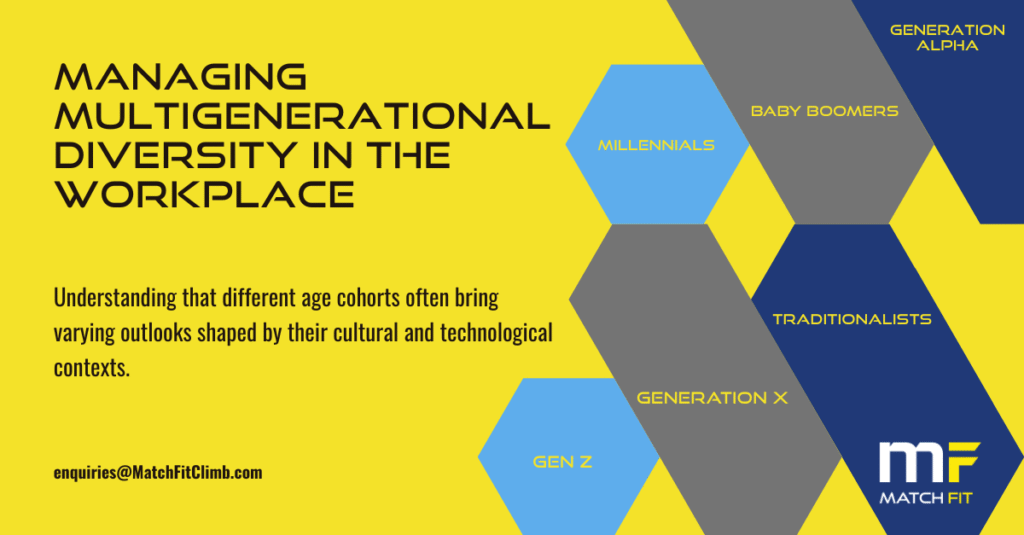
Managing multigenerational diversity in the workplace

This article was updated in May 2026 to reflect new trends and insights.

Research has shown that the proportion of workers aged 55 and older is projected to reach nearly 25% of the workforce in G7 countries by 2031, reflecting a significant rise in age diversity in the workplace.

As people remain in the workforce longer, today’s organisations are increasingly composed of age-diverse teams. Employees in their 20s now collaborate daily with colleagues in their 60s and beyond. This shift brings new levels of diversity in values, expectations, and attitudes toward work, but also poses a challenge for managers – how to lead in a way that uses this age diversity for high performance rather than letting it create division. 

The key to effective management lies in understanding the lived experiences of team members and using that insight to shape leadership, communication, and culture strategies. A tailored, reflective approach like MatchFit’s phenomenological methodology can help managers work through this terrain effectively.

Understanding generational differences

Managing age diversity in the workplace means understanding that different age cohorts often bring varying outlooks shaped by their cultural and technological contexts:

  • Baby boomers – may prioritise loyalty, hierarchy, and job security.
  • Generation X – values independence, flexibility, and pragmatism.
  • Millennials – tend to seek purpose, feedback, and work-life balance.
  • Gen Z – is digital-native, values inclusivity, and thrives on rapid growth opportunities.

A 2023 Pew Research Center study found that Millennials and Gen Z are significantly more likely to value diversity and flexibility at work, while Baby Boomers and Gen X place higher importance on job security and structured communication. These are, of course, generalisations but they highlight why a one-size-fits-all approach to management is no longer viable.

Moving from awareness to alignment – bridging the generational divide

Awareness of these differences is a start, but sustainable high performance comes from alignment. MatchFit’s CLIMB to Align programme addresses this directly, helping leadership and management develop strategies that support intergenerational collaboration. A Harvard Business Review analysis found that companies with strong intergenerational collaboration practices reported 10% higher employee engagement and 5% higher productivity than those without such practices.

A multi-generational workplace can bring significant advantages to organisations. More experienced Gen X and Millennials can contribute valuable insight, mentorship, and organisational knowledge, while Gen Z employees often introduce fresh thinking and digital expertise. Diverse teams offer a broader range of perspectives and experiences, driving stronger innovation and more creative problem-solving.

By engaging in open dialogue and co-creating plans that respect differing values, work styles and learning, managers can bridge the generational divide and manage age diversity in the workplace more effectively.

Coaching across generations

Developing strong coaching skills is essential in this environment, especially as Millennials who now account for nearly 40% of the working population prefer a coaching leadership approach.

Reverse mentoring can also be beneficial; pairing younger employees with older colleagues in mentorship relationships where both parties learn from each other. Younger employees bring digital fluency, knowledge of emerging technology, communication and collaboration tools, and insights into changing customer and workforce expectations, while older employees can share industry and organisational insights and professional experiences.

MatchFit’s WeCLIMB Coach module equips managers to adopt a coaching mindset, one that replaces assumption with curiosity. Coaching encourages managers to ask, “What motivates you?” rather than assuming what worked for them will work for everyone.

This coaching approach enables managers to unlock individual potential, irrespective of age. It also strengthens psychological safety by showing that diverse perspectives are not just accepted but valued.

Building self-awareness and adaptive leadership

Managers need to be attuned not only to others’ differences but also to their own leadership tendencies. Increasing self-awareness helps leaders understand their own motivational drivers and behavioural patterns. This reflection is the foundation for adaptive leadership, adjusting one’s style to fit the needs of the team.

Communication preferences can also be a challenge. For example, a manager who tends to value face-to-face interaction might need to stretch to accommodate younger colleagues who are more comfortable with asynchronous digital communication. Conversely, younger managers may need to learn how to build rapport and trust with older colleagues who prefer more structured communication.

Creating shared purpose through culture

A unifying purpose can transcend generational differences and help to manage age diversity in the workplace. A focus on culture transformation is critical here. By engaging the entire organisation in a discovery phase, including one-to-one interviews and staff surveys, it is possible to uncover the cultural nuances that influence team dynamics.

From these insights, tailored interventions can be deployed to realign the culture with business priorities. A Deloitte Global Human Capital Trends report found that organisations with a strong sense of shared purpose and inclusive culture are significantly more likely to have high-performing teams, regardless of generational makeup.

Millennials, who now make up a significant proportion of the mid-career workforce and are often in leadership roles, place great importance on team alignment with a sense of purpose.

When employees of all ages see how their work contributes to a larger goal, they are more likely to engage and perform—despite their differing personal expectations.

Embedding continuous learning and feedback

One shared trait across all generations is the desire for growth, though how they experience it may differ. Regular feedback, coaching conversations, and opportunities to contribute to strategic initiatives can keep all team members engaged and growing.

Measuring what matters

A multigenerational team can only thrive if progress is measurable. Interventions need to evaluate success on a number of levels, including initial reactions, new understandings of team members, behavioural changes, and ultimate results for the team or business. This ensures that managers not only implement strategies but see a tangible return on investment through improved collaboration, engagement, and performance.

If you’d like to learn more about our MatchFit leadership programmes, take a look at our information pages here, or why not get in touch? enquiries@matchfitclimb.com

Managing multigenerational diversity in the workplace Read More »

How to influence and shape your career path

Welcome to the third of a series of articles based on a recent OxTalks podcast in which Chris Oxley (Managing Director, Oxley & Partners) and Bradley Honnor (MatchFit Managing Director) discuss leadership and development training.

In this third episode, Chris explores direction. He explores with Bradley the challenge that many of us face; we have good work habits, we are resilient, and we are consistent – and yet… we aren’t where we want to be with our work/ life/ relationships.

How can I work out where I want to get to?

Bradley explains the value of moving forwards, both in terms of learning but also as a prevention against inertia. He explains why waiting for a complete understanding of the goal may lead to indecision. The value of coaching for teams and individuals in determining direction is explored and how this complex topic requires a degree of self-awareness, reflection and acceptance of the value of feedback.

What next?

This episode wraps up with a discussion about how to take decisions forward – we know where we want to get to, so what do we need to do next? Bradley explains how the CLIMB programme works with teams and individuals to create pathways that will lead to high performance underpinned by key business metrics to track change and improvement.

Transcript

Chris: It sounds like a big part of this is forming good habits right? The consistency part. And that develops the resilience. I certainly noticed this in myself at times, and from other people that I’ve spoken to.

There are many individuals who want to work hard, but they’re almost directionless. They don’t know what to work hard on.

And I know there’s program that you’ve developed at MatchFit called the CLIMB program. Is that right?

Bradley: Two matters come to mind here. First of all, that can be a difficult  place to be. I remember that myself.

A good analogy is that I felt I was in a racing car and I was revving the engine, and I had the will to win the race, but I didn’t know where the race was taking place. I didn’t know what direction to go in. I wanted to be successful, but in what way and how, and that was a very frustrating space to be in.

And all I can advocate in that particular set of circumstances for someone is to find a way to move forward. Paralysis is the death of any development. It might not be your ideal direction. In fact it probably won’t be your ideal destination first time around. Many people do a number of things in their lives, me included. Working in different cultures and environments, and with different responsibilities.

But it’s the sense of moving forward and finding what you enjoy, what do you like, what does fit with you and what doesn’t.

So I’ve put my racing car into first gear and I’m speeding off. I’m starting to travel and to look at my route as I go, and the landscape changes. I’m seeing things on the horizon that I wouldn’t have seen had I not set off.

You really do have to push away and swim into the ocean to see the next land mass. That moving forward in some capacity is really beneficial.

So yes, the CLIMB program does encapsulate that ethos of: we are where we are today, but what does better look like? I’m a real advocate of let’s not wait until we see the whole vision in front of us. If we can do that, then fabulous. But sometimes, if we wait, that’s where indecision comes.

Chris: Let’s pull back a little bit and focus on that, because I think this is quite an important point we’ve almost stumbled across here, and I’m a fair believer in that as well.

It’s pick a direction, move forward, and the very least you will gain is knowledge. And I think it can be incredibly paralysing to some people to just constantly overthink a step on what way to go, without the realisation that actually, you will still gain knowledge going in this direction.

And I think a big part of this, in my personal experience, is having the courage to be very self aware of what do you actually want to achieve out of this?

And it can be difficult I think, to sit down and have that conversation with yourself. Is that right?

Bradley: When we think about development, we need to consider how important self reflection and self awareness are. And they are fundamental.

There’s the Johari Window model that suggests there are aspects of our personality that other people know about and I know about. There are aspects of my personality that maybe I know about and other people don’t know about. But there are also aspects of myself that nobody knows about, including myself. And there are other aspects that other people know about me, but I don’t know myself.

So we’ve really got to be open to feedback. We really need to be asking for and seeking feedback from other people so that that can increase our awareness.

And we need to avoid being defensive and shutting down feedback but open ourselves up to what we are hearing so we can learn and adapt. If we just plan and do without that review, that self reflection, we won’t learn. We will just keep doing the same thing over and over. So being open to the feedback of others is very important. And the more we throw ourselves into new experiences and move forward, as we’ve been talking about, the more feedback I get from myself about how I am dealing with those different situations. So those two things—that self reflection and the capability to have people give you feedback and not be defensive or justify the reasons why you did what you did, but just to hear that feedback and take what is useful for you and your own development—yeah, that’s fundamental.

Chris: Another guest of mine, a psychologist within sports, was talking about when you’re increasing resilience, specifically your performance under pressure, what you’re talking about there is the cognitive piece; the ability to review, develop and move forward. And unless you’re doing that piece, it doesn’t all come together as it needs to. It’s almost three steps there. Again, it’s coming from that behavioural science psychology that there’s so much evidence here that this is the process we need to go to, but it can be transferred to different areas and scenarios. It’s effectively maximising the human brain within a particular context; home, work, relationships, whatever it needs to be. But it seems imperative that the more and more I speak to experts such as yourself and the other individuals that I’ve had on there. So that it’s great to hear. When we’re looking at MatchFit, how do you explain that?

Bradley: We’re a niche consultancy focusing specifically on high performance. So very much in terms of what you just said: how do you define your performance currently, what criteria you’re using, and what is needed in order to move to the next stage of performance yourself or as a team or as an organisation.

And our role within that is to do some fact finding about what is it that people are saying about the current levels of performance of those individuals or teams or the organisation generally.

What do they feel would be the really beneficial things to look at in terms of what to engage in, to really maximise the opportunities to perform at a higher level.

And we then feedback those key themes from the analysis exercise with a view to facilitating workshops and individual coaching to enable those individuals, teams and organisations to move towards their priorities and start to think about what they need to do differently.


We hope that you enjoyed this conversation and remember look out for Episode 4 soon. You can listen to the whole conversation here The Transformative Impact of Personalised Development with Bradley Honnor
 

If you’d like to learn more about our MatchFit leadership programmes, take a look at our information pages here, or why not get in touch? enquiries@matchfitclimb.com

How to influence and shape your career path Read More »

How to build a high-performance culture in your organisation

Understanding how to build a high-performance culture isn’t just about implementing new HR policies or hosting the occasional team-building event. It’s a strategic, long-term commitment to reshaping how people think, communicate, and collaborate. The good news? This kind of transformation is achievable, and many organisations are already reaping the benefits.

Why alignment is critical in building a high-performance culture

At the core of culture is one critical ingredient: alignment. Every team member—from the C-suite to the front line—must clearly understand the organisation’s mission, what success looks like, and how their role contributes to it. Without this unified direction, people may work hard but ultimately pull in different directions.

At MatchFit we start helping organisations build a high-performance culture through a discovery phase. We conduct staff interviews, surveys, and gap analyses to highlight the gaps that may be hindering the organisation, teams and individuals achieve their strategic goals. These in-depth investigations ensure the interventions we design are tailored to target the organisations specific challenges.

Leadership as a foundation for high-performance culture

One of the first and most impactful steps in learning how to build a high-performance culture is developing individual leaders and teams to be more impactful. Strong leaders don’t just give orders, they set the tone, model behaviours, and reinforce values across teams.

According to a 2023 SSRN-published report, “The Role of Leadership in Changing Organizational Culture”, the peer-reviewed research confirmed that leaders act as “cultural architects,” defining core values, norms, and behaviours. Effective leaders foster innovation, adaptability, and inclusivity, helping organizations thrive in changing environments.

MatchFit’s CLIMB programme supports senior leaders in uncovering their communication patterns and leadership influence. By linking this personal insight to real-time business challenges, leaders learn to embed cultural shifts organically and sustainably.

Wider organisational engagement is key

As well as leadership, it’s also vital to engage the wider organisation. This isn’t about broadcasting a new vision. It’s about engaging in two-way conversations that connect the cultural shift to employees’ success and wellbeing.

MatchFit’s WE CLIMB coaching module trains line managers in coaching skills that unlock team performance and build a responsive, trusting and engaged environment. When employees feel heard and valued, they naturally take more ownership, which is an essential trait in any high-performance culture.

Consistency is key to a sustained high-performance culture

Another overlooked component of building a high-performance culture is operational consistency. How meetings are conducted, how performance is evaluated, and how learning is reinforced all matter.

MatchFit’s interventions are integrated directly into day-to-day activities.

Using technology and measurement to support cultural change

Technology also plays a supporting role. Tools such as employee listening platforms and collaboration apps can help reinforce desired behaviours, especially in hybrid or dispersed teams. However, they should support—not substitute—authentic leadership and human connection.

Measurement is another vital element. It’s not enough to say a culture is changing—you need to show it. MatchFit’s proof of learning model tracks change across four levels: reaction, learning, behaviour and results. This evidence-based approach helps organisations fine-tune their efforts and demonstrate return on investment.

One change that the operations head at a financial services firm noted as ‘music to my ears’, was on the people survey (the leadership and managing change theme), which saw a huge positive increase of 14%.

As one client from the civil service sector reflected, using this structured measurement approach gave them “clear visibility of what was shifting and why,” which in turn helped build confidence across stakeholders and maintain momentum.

Reinforcement and continuous learning

Sustaining a high-performance culture also requires reinforcement mechanisms. These may include ongoing development opportunities, recognition programmes, or cross-functional projects that promote collaboration and innovation. MatchFit’s CLIMB Spotlight modules are designed to keep focus sharp by addressing specific challenges in a modular, bite-sized format.

Final Thoughts – how to build a high-performance culture that lasts

To conclude, building a high-performance culture isn’t about trying to achieve perfection, it’s about making consistent, strategic progress. With clear communication, a vision and open engagement, your organisation can develop into a place where people can perform and thrive to their optimum.

If you’d like to learn more about our MatchFit leadership programmes, take a look at our information pages here, or why not get in touch? enquiries@matchfitclimb.com

How to build a high-performance culture in your organisation Read More »

MatchFit’s partnership with the Ministry of Justice – a very personal perspective

Jackie Woollaston, Head of Corporate Services, HR Casework in the MoJ’s People and Capability team, shares her personal experience working with MatchFit as a client.

Initially, Jackie participated in MatchFit’s full CLIMB programme.

“When I initially got involved with MatchFit, they were delivering their CLIMB programme to the team,” said Jackie. “CLIMB for us was something that evolved over the years and it allowed us to work through challenges in detail. We then moved onto what we called CLIMB Spotlight which was a very focused hour’s session on what we, as the client, felt were our priorities. MatchFit would take our feedback and design the CLIMB Spotlight sessions, and it was because of their high levels of responsiveness and agility that they were able to do this so well.”

One of Jackie’s main areas of involvement was the Shadow ExCo programme—first as a participant, then later as the manager running the initiative for the wider HR Casework team.

“For me the relationship and support progressed onto the Shadow ExCo programme, evolving off the back of CLIMB. We wanted to do some work specifically to develop SEOs and HEOs. One of the things I liked so much about Shadow ExCo was its ability to upskill people and push them out of their comfort zone,” said Jackie.

The HR Casework team launched with a cohort of 10 participants working on five strategic projects, each intentionally outside their area of expertise. All projects were planned through a combination of collaborative internal and external discussions.

“MatchFit’s agility was again important meaning they were able to quickly take our thoughts on board and shape the programme so that it directly met the requirements we had at the time,” said Jackie.

At the time, Jackie recorded her reflections on the programme and her personal development journey:

“Starting the Shadow ExCo Programme I knew that I would have the opportunity to develop my skills working on a team project. To support this, I was appointed a MatchFit coach and started working with a mentor. This part of the programme has been very rewarding, and my leadership skills have continued to improve from attending workshops, self-learning and participating in action learning sets. Knowledge is built on throughout the programme, so I was able to apply my new skills to my project and my own work from the very first workshop.

The Shadow ExCo Programme provided an opportunity for personal development. One of the first things my coach asked was what did I personally want to achieve from the programme. I had recently started a period of temporary promotion, and I told my coach that I wanted to finish the programme with the skills to help me achieve the next grade. My coach helped me keep site of this goal and towards the end of the programme I was successful in promotion to the next grade. The work that I have undertaken on my project and the skills that I have developed gave me the belief and determination to achieve my goal. I would recommend this programme to anyone who not only wants to be a driving force for team improvement but who also has a personal desire to improve and progress.”

When Jackie took over managing the programme, the approach was structured from the start. Expressions of interest were sent out to gauge applicant interest, with those from the first cohort available to speak to prospective participants about what to expect. Team leaders also carefully matched applicants to ensure the programme suited them.

“When we started it was mainly SEOs but then we got HEOs involved so different levels of people would be working together,” said Jackie.

One element Jackie particularly valued was the involvement of managers from clients across the Civil Service, who shared insights into their career development journeys, offering participants invaluable advice. Attendees were also encouraged to find mentors who best suited their needs.

“I still speak to my original mentor and have a strong relationship there,” said Jackie.

A key aspect of the Shadow ExCo was presenting the results of the participants’ projects to the Senior Leadership Team (SLT).

“In subsequent years when I was part of the SLT I looked forward to those on the programme coming and presenting, because I had been on the other side,” said Jackie. “It was great to see the work they’d done and how they had measured the impact. The fact that the projects were there to solve an actual business problem gave them a legitimate purpose and made them even more valuable.”

Strong programme results

Both the MoJ and MatchFit were careful to measure the results of the Shadow ExCo initiative, which proved to be overwhelmingly positive.

Key cohort achievements included:

  • 46% of attendees obtained further promotions
  • 8% changed role internally (via the Job Placement Programme)
  • 34% took on long-term additional duties
  • 4% secured new opportunities within the Civil Service
  • 11 new roles were created as a direct result of successful projects

For clients, the main benefit was enhanced productivity through increased capability. For participants, Shadow ExCo significantly boosted engagement, delivering sustainable personal growth and the development of transferable skills.

“I enjoyed working with MatchFit, especially on the Shadow ExCo,” said Jackie. “I enjoyed watching the projects move forward and how they made a difference. The communications project has resulted in us having our Pulse Bulletin that goes out every Monday containing pretty much everything that we want to share with the team, so we don’t keep having to do that all during the week unless it’s urgent. And that’s still going.

It was also a time when I was looking to move up, and being on the Shadow ExCo helped me develop professionally and get that promotion.”


If you’d like to learn more about our MatchFit leadership programmes, take a look at our information pages here, or why not get in touch? enquiries@matchfitclimb.com

MatchFit’s partnership with the Ministry of Justice – a very personal perspective Read More »

What is a high-performance culture?

At a time where agility, innovation, and productivity are no longer optional, building a high-performance culture has become central to organisational success. But while the term is often used, its meaning is not always clear so in this article we answer the question what is a high-performance culture, what does it really mean to have one and why does it matter?

What is a high-performance culture? At its core, it is an environment where people are enabled and encouraged to perform at their best—not occasionally, but consistently. It goes beyond meeting quarterly targets or exceeding KPIs. It’s about embedding behaviours, mindsets and practices that align people’s daily work with the broader goals of the business.

One major study found that 78% of Fortune 1,000 CEOs believed culture to be one of the top three factors affecting their firm’s performance. This correlation isn’t coincidental. When culture is deliberately shaped around high performance, everything from decision-making to employee engagement is positively influenced.

The building blocks of a high-performance culture

While every organisation is different, there are certain features commonly found in high-performance cultures. These include clear expectations, psychological safety, meaningful feedback, and a deep sense of purpose. Employees understand not just what is expected of them, but why it matters—and they feel equipped and supported to meet those expectations.

MatchFit, for example, focusses on a methodology based in the lived experiences of employees – both in and outside of the workplace. By using a phenomenological approach, they help organisations uncover what performance really looks like day-to-day, from the ground up. This understanding enables leaders to shape cultural change that is not only strategic but more closely related to the realities and needs of the employees within their organisation.

A high-performance culture also involves alignment—between leadership and teams, between personal and organisational values, and between strategy and execution. When people are aligned, performance is not forced—it flows.

The role of leadership and communication

One of the most decisive factors when looking at what is a high-performance culture is leadership. According to McKinsey & Company, effective leadership behaviours— solving problems effectively, operating with a strong results orientation, seeking different perspectives and supporting others—have the highest correlation with organisational health and performance. Leaders who model the right behaviours don’t just inspire their teams—they set the tone for the culture itself.

Communication is another critical piece. In cultures where communication is clear, transparent and two-way, employees are more likely to be engaged and proactive. MatchFit’s work with organisations often begins with a deep discovery phase, involving staff interviews and surveys. This not only gives people a voice but ensures that cultural initiatives are grounded in real experiences rather than top-down assumptions.

Why it matters more than ever

In a post-pandemic world marked by hybrid work, shifting employee expectations, and increased competition, culture has become a defining advantage. A high-performance culture isn’t just about pushing people harder—it’s about removing the barriers that stop them from doing their best work.

For example, when HM Prison Service partnered with MatchFit, their tailored interventions led to noticeable improvements in team dynamics, leadership effectiveness, and overall workplace culture. This echoes what Gallup’s global research has long shown: organisations that prioritise employee engagement—an essential component of performance culture—see 23% higher profitability and 18% higher productivity.

Final thoughts

So, what is a high-performance culture? It’s a workplace where people feel trusted, supported, and clear on what success looks like. It’s led by individuals who communicate well, lead with purpose, and model the behaviours they expect from others. And importantly, it’s measured—not just by output, but by how people grow and contribute over time.

Creating such a culture takes time, intention and the right partnership. People-development consultancies like MatchFit bring the insight and methodology to make this transformation practical and measurable through programmes such as CLIMB. As more businesses realise that culture is not just the soft stuff—it’s the foundation for performance—the question isn’t whether you can afford to build a high-performance culture, but whether you can afford not to.


If you’d like to learn more about our MatchFit leadership programmes, take a look at our information pages here, or why not get in touch? enquiries@matchfitclimb.com

What is a high-performance culture? Read More »

Delivering impact through partnership: the MOJ HR Technical Consultancy and MatchFit story

Background

David Wade, Head of HR Technical Consultancy Service at – MOJ Civil Service HR Casework, talks about the partnership with MatchFit over the last five years, and how this has helped his department deliver a more holistic service to clients.

“I’m responsible for a team that delivers HR services to a large number of government departments and agencies,” said David. “The partnership with MatchFit was born out of a number of challenges the HR Casework team had observed, and it helped to fill what was a gap in the wider HR Offer to the Civil Service departments we work with.”

Civil Service HR Casework often worked with departments to support and build capability of line management through what he describes as generic leadership programmes and training. However, there were limitations to what was readily offered to address issues in a very targeted way, particularly around people management and employee relations. And it was from this need that the partnership came about.

From an HR Casework perspective, there was an increasing need for a partner that could bring a slightly different perspective; the ability to build leadership and line management capability.

“MatchFit have offered a point of difference for us, that independent voice able to offer another perspective and help us engage with clients in a slightly different way,” continued David. “And it’s been particularly successful. The mix of HR, employment law experience and Civil Service knowledge from our side coupled with leadership consultants with experience from different industries allows us to provide a tailored service for each client, which is really beneficial.”

Throughout the partnership, MatchFit spent time understanding the environment they are working in. This is particularly important from David’s perspective, especially as many Civil Service organisations they are working with—including the Prison Service, Cabinet Office and DEFRA—have unique environments and want to work with people that understand them.

“That’s something we pride ourselves on as a Casework team, and it’s also naturally important to MatchFit. They spend lots of time building client relationships and understanding the environment and the people to ensure they get the best out of the programmes. And that, I think, ultimately is one of the reasons why the MatchFit service is so positively received,” said David.

A positive and tangible impact on clients

“The feeling from both the Civil Service HR Casework team and MatchFit is that the joint approach is hugely valued,” said David. “And the work generates high levels of engagement from individuals and teams, including leadership teams who traditionally may not always engage in that type of activity so positively.”

Having the Casework side of the partnership also offer a more detailed insight into the workings of Civil Service departments allows the partnership to tailor its approach even further.

“The approach gives individuals a voice that they might not have felt they had previously, especially with the Civil Service often considered quite process-driven and procedural in its nature. And that opens up a new way of thinking with participants challenging themselves more than they had been doing previously,” continued David.

The MatchFit Consultants have worked across many different industries, whether in the Civil Service or the private sector and have been able to bring different experience and ways of thinking to the leadership teams across the Civil Service.

“One thing MatchFit does really well is identify the right consultant for the right group of leaders,” said David. “It’s definitely not a case of one size fits all. It’s very much about trying to tailor the approach that we offer, and that extends through the whole partnership for both Casework and MatchFit. That is hugely important.”

Impact in numbers

A significant focus of the partnership is measuring the impact of the work at every stage so that the impact is clear to every stakeholder.

In all, the partnership has worked with 12 Government Departments and 69 Business Areas.

60 CLIMB programmes with senior leadership teams and 600+ management workshops have been delivered.

Across all departments, the impact has been significant:

  • 99% of survey respondents reported that the management workshops are a positive experience
  • 97% would recommend the management workshops to a colleague
  • 85% of survey respondents increased in confidence following the management workshops by an average of 34%

Across HM Prison and Probation Service, the results have been even stronger:

  • 97% of survey respondents would recommend the CLIMB Programme to a colleague
  • 96% felt the CLIMB Programme has had a positive impact
  • 100% felt that MatchFit Consultant understood the business areas unique challenges.

On average and over the course of the HR Technical Consultancy Service the business areas worked with reported an:

  • 8% positive increase in their perception of Culture
  • 2% positive increase in their perception of My Manager
  • 6% positive increase in their perception of My Team
  • 6% positive increase in their perception of Senior Leadership
  • 6% positive increase in their perception of HR Management

“One of the observations at the very start, pre the work with MatchFit, was that interventions of this nature were often not measured,” said David. “There would be an issue, we would deploy a solution but there was no real measurement against the impact of that solution, both in the immediate aftermath and also over a sustained period of time.”

That was something the team were acutely aware of and wanted to address – to measure the impact of the service they deliver on both managers and leadership teams they work with.

“We want to assess the reaction to the work we are doing – the behaviour change, the learning and ultimately the result. Having a tangible, quite simple, evaluation model really lends itself to that,” David continued.

Installing a measurement process means the team can continue to challenge itself and help the clients hold themselves to account. It is now possible to understand the progress groups are making and engaged in, and that could be used to keep them engaged and motivated.

“That’s important, because often you do this type of work and focus on the next day and the day after that but lose sight of the overall progress that’s being made,” said David. “And measurement allowed us to look at that progress.”

Measurement also helps the partnership to demonstrate a return on investment in the work that that clients are ultimately funding.

The team utilises quantitative metrics to understand progress. Surveys are undertaken both at the start and end of programmes to see the shift in team leadership culture and HR people management within the groups. This provides a helpful metric to understand progress, but also gaps that still need to be addressed. Metrics are collected around issues such as how confidence has increased and average working days lost  to understand how individuals, managers and leaders, were engaging with the HR aspects of their role.

“We are able to track these over a sustained period of time, even beyond the conclusion of the programme,” David said. “So we get a feel for how the work we do has a sustained impact beyond just the time we spend with clients. And we’ve seen really positive results across the board in regards to that sustained impact for the departments.”

Clients are provided with structured reporting packs, both at the initial Analysis Stage, throughout and post programme. The means that senior leaders receive dashboards following every intervention delivered to their management team, and also following each client group session with their senior leadership team.

“So over the course of the programme, they receive tangible output that they could utilise day to day. And then at the end of the programme, they receive a report that shows them where they started, what they’ve done and where they are going,” said David. “It’s as much about outlining the successes as it is highlighting the focus areas for clients. So yes, the programmes are both tailored and very well structured in terms of delivery and evaluation, which means that all parties really know where they stand.”

“Overall it’s been a great partnership that has strongly benefitted the a range of departments and agencies within the Civil Service,” concluded David.

If you’d like to learn more about our MatchFit leadership programmes, take a look at our information pages here, or why not get in touch? enquiries@matchfitclimb.com

Delivering impact through partnership: the MOJ HR Technical Consultancy and MatchFit story Read More »

Making a measurable impact within a mid-sized financial services firm

Background

Having helped and supported the leadership team to become more effective and more impactful as managers to the wider staff group in this mid-sized financial services firm [Supporting transformative SLT change at a mid-sized financial services organisation], MatchFit continued its work, this time with lower-management grades and specific teams.

Empowerment

The Head of Operations, picks up the story.

“Tim [a MatchFit consultant] was very good at using models that resonate with us as a team and office. One of them was about ‘moving the decision to where the information lies’,” she said.

This and other interventions have helped shift the thinking within the organisation towards empowerment where managers at all grades now have the confidence to make decisions without any fear of repercussion.

“Not only that,” said the operations head, “But they can feel supported by the SLT in those decisions.”

And that’s been transformational, because not everything has to come up through the different hierarchies into the SLT to then make the decisions. This has created a safe space where people feel supported and are helped to make informed decisions, which has made an immense impact to the whole organisation.

Developing the next level of talent

One of the most beneficial pieces of MatchFit’s work was the CLIMB Shadow ExCo Programme, an immersive and interactive programme that develops future leaders and engages talent to deeply understand how leadership should work within an organisation.

“It was just the most brilliant opportunity for a cohort of individuals across the office to be engaged in.

At the time, an organisation-wide staff survey wasn’t as positive as it should have been for a number of themes but the Shadow ExCo was an opportunity to pick up on some of the key areas with the survey and build a programme to address them.

“Via the Shadow ExCo, we were able to undertake projects around innovation, around what makes a good manager, around engagement, around induction, around managing a quality service, and run those projects throughout the course of the programme with those who were on the cohort at the time,” she continued.

The 12-month programme had a hugely positive impact on both the cohort and the wider business too.

Improving the staff survey scores

“We were keen to see how the 2024 people survey results would differ from those in the previous year and to see the benefit from all the work, including the Shadow ExCo programme,” she explained.

The results were unprecedented.

“For the first time ever we’ve seen a positive increase across all our core themes, and it is evident that the work MatchFit has done, the programmes they have run, their interventions have all come through beautifully in our staff survey results,” the Head of Operations continued.

A score related to how people perceived their manager for instance, increased significantly by 11 positive percentage points. This is a huge number which the operations head put down, in part, to the Shadow ExCo programme which helped equip managers with the tools and skills they need to improve their managerial ability.

Other interventions like those relating to having difficult conversations and what a good conversation looks like, again helped to improve scores. Another really positive score was around L&D, which saw a positive percentage increase of 14%.

“That is off-the-scale massive. And again, it’s all the development opportunities we’ve been able to afford for our staff over the past 12 months both internally and with MatchFit’s help which means staff feel more invested in, valued and listened to.” she continued.

One change that the operations head describes as ‘music to my ears’, was the leadership and managing change theme, which saw a huge positive increase of 14%.

“Again, I think it was absolutely as a result of MatchFit doing all that transformational work with the leadership team, and also all their engagement work with the Shadow ExCo programme,” she said.

The work has helped colleagues increase their perception of the SLT in terms of transparency around decision making.

Improving engagement across the organisation

One of the projects on the Shadow ExCo programme was engagement, an important theme for the organisation.

“As a result of what we did with MatchFit, engagement is at the heart of everything we do now. It sounds so simple, and you might ask why wasn’t it at the heart of everything that we did previously. But we were just stuck in that rut of we’ve got our jobs to do. We’re so busy, we haven’t got enough resources, we just need to get through the day-to-day work. That makes it easy to forget that the softer side of what we do is so important. MatchFit really opened our eyes to that,” she said.

Because of the specific engagement work in the Shadow ExCo programme, the organisation now has two engagement champions who regularly work with the senior leadership team to feedback on issues that have arisen and also successes that colleagues want to be fed back to the SLT. A ‘Colleague’s Voice Committee’ has been formed and meets every couple of months.

“We have success boards. We have a new intranet now, which is a one-stop-shop for all our information needs. So it’s really facilitating more regular interaction amongst the senior leadership team with a whole host of people across the organisation. Again, it sounds really, really simple, but it has such a transformational impact on us as a whole,” she continues.

Overall, it has been a lot of hard work to get the organisation to where it is now. But the collaborative joint effort with MatchFit and the opportunity to recognise and address challenges has shone through in the people survey results and benefitted the entire team and business in a positive way.

If you’d like to learn more about our MatchFit leadership programmes, take a look at our information pages here, or why not get in touch? enquiries@matchfitclimb.com

Making a measurable impact within a mid-sized financial services firm Read More »