MatchFit Methodology

Supporting transformative Senior Leadership Team change at a mid-sized financial services organisation

Background

In 2024, a mid-sized financial services firm commissioned MatchFit to support with improving the effectiveness of the organisation in line with a new leadership vision. Their Head of Operations, someone who has been heavily involved with MatchFit’s work, was kind enough to discuss the impact of MatchFit’s interventions and, in particular, their senior leadership team who were tasked with implementing the new vision.

CLIMB Programme

“Their [MatchFit] CLIMB programme has had a transformational effect on the SLT group,” said the operations head, who has leadership oversight of three main divisions within the company.

As an organisation, they needed new impetus and, with a new leader looking to put their people at the heart of everything they do, a huge cultural shift was needed to make that work. For the new philosophy to be effective and to embed the change, the organisation needed to start from the top and create a cohesive, forward-looking and modern senior-leadership team.

“And for me, that has been the biggest contribution from MatchFit,” said the Head of Operations.

MatchFit Consultants

Tim Forman [a MatchFit consultant] began working with the SLT at a time where the makeup of the team wasn’t gelling as well as it needed to. Colleagues were coming at the challenges facing the organisation from different angles and there was a lack cohesive direction. As a result, the effectiveness of the team wasn’t where it needed to be and this was affecting the performance of the entire organisation.

“Tim really worked hard with the SLT to bridge and create a more collaborative team moving forward, and importantly I think, to ensure that we all felt valued, and that all opinions mattered, no matter how different,” continued the Head of Operations.

MatchFit worked with the SLT both individually and as a group, initially to really get to the bottom of what issues needed to be addressed.

“We hadn’t had that type of intervention before. We hadn’t had that critical eye from outside of the office. Having those independent insights of us individually but also as a collective, was really, really important. We began to value our differences and our different perspectives which, in turn, made us more effective as an SLT,” she said.

With the help of MatchFit, the SLT worked on setting clear priorities and plans for the future.

“That sounds really simple, but we hadn’t actually done before in a structured way,” she continued.

The team was encouraged to step outside of their individual roles and put on their SLT hats at appropriate times. This meant not always firefighting around individual roles or teams but looking at issues from an office-wide perspective.

Transformative Impact

It made a transformative impact according to the Head of Operations: “The programme very quickly made us positively question what we wanted to achieve as an SLT and how we would work to collaboratively set goals. There was a real shift in dynamics, from it being, multiple camps feeding into the SLT, to being that one voice and that voice feeding through to the entire office.”

This created a positive shift in the office towards the SLT and its purpose and enabled them to establish a more robust governance structure and accept empowerment as key to shaping their structure. With the team setting a clearer vision and goals and communicating them effectively, there is now much more respect from the wider office in terms of what senior leadership team does and the vital role it plays in driving the organisation forward.

If you’d like to learn more about our MatchFit leadership programmes, take a look at our information pages here, or why not get in touch? enquiries@matchfitclimb.com

Supporting transformative Senior Leadership Team change at a mid-sized financial services organisation Read More »

Why it’s essential for people-development consultancies and HR teams to work together

The background to the partnership between MatchFit and the Ministry of Justice

For the last five years MatchFit has worked in partnership with the Civil Service HR Casework Team. The teams’ close working relationship has been a major driver behind the successful impact of this partnership with Civil Service clients.

We sat down with Finola Neligan, an HR Technical Consultant within the MOJ who has worked closely with MatchFit consultants over several years to get her view of the partnership.

“I am an HR Technical Consultant, sitting within the HR Casework Team,” says Finola. “Our overarching aim is to upskill and improve the outcomes line managers across the Civil Service can achieve in the course of their people management. My role specifically is to work with business areas across the Civil Service, not only within my department, but others as well, to support them when it comes to challenges such as performance, sickness management or cultural concerns. I then support them to achieve positive outcomes and they upskill in the process.”

Finola was first introduced to MatchFit when they worked with her team internally, providing internal L&D support including one-to-one coaching. From there, a formal partnership was created to deliver a service for clients (other departments and agencies) across the Civil Service. It was at that stage that Finola moved into the role of HR Technical Consultant to work within the framework of the partnership.

Setting high performance goals

The partnership’s aim, and the work undertaken with numerous clients over the years, was to enable and support sustainable high performance in Government departments and the teams within. The activity has been instrumental in improving not only culture, but also the performance of business units.

“We worked closely with MatchFit to create a programme of analysis and delivery that helps to support not only leadership teams, but also management teams within these business areas,” continued Finola. “The purpose of the analysis is to explore line management capability and the employee experience, identifying what is working well and where the challenges may lie. Coming from an HR background I have access to the rich HR data in relation to those business areas and can bring that expertise to the table. We look at the people issues in terms of HR cases— attendance management or performance etc.—and MatchFit comes in to gather and act on the qualitative data around what it’s like to be a member of staff in that business and how that can be improved. It works really well, because we’re able to combine both that quantitative data and HR insights with their qualitative findings, which provides a really robust analysis of what is actually going on in that business unit.”

Why the partnership approach was a key success factor

In terms of the need for a close working relationship with a consultancy like MatchFit and Civil Service HR Casework, Finola was very positive.

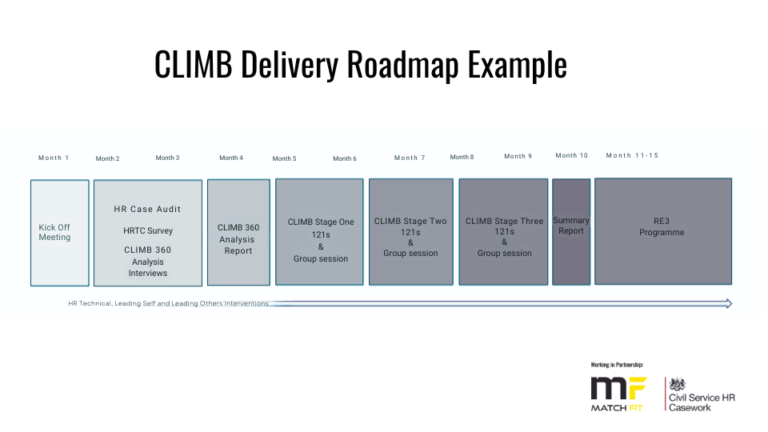
“It was pivotal, to be honest,” she says. “We needed to ensure there was constant communication between the two parties, because MatchFit was supporting in relation to the leadership aspect of the teams we were involved with. They would deliver the CLIMB programme, which would include one-to-one sessions and group sessions with the senior leadership team. Working in tandem, we would then deliver a number of training interventions at a management level.”

There was a need to be very clear on the objectives of that work, the analysis findings and how that fed into the work undertaken with staff within the businesses.

“Our constant communication meant that any kind of issue or theme either at the senior leadership level or at the management level, could be fed into both aspects of the programme, so that ultimately we were helping to improve communication in the business,” said Finola. “There needed to be, and was, a synergy to the work we were doing. That would feed into the outcomes towards the end of the programme that we could then present back to the client in terms of our consistent approach at different levels. And this is why it’s been successful.”

For Finola and her colleagues, how joined up they were as a team to capture and deal with issues coming out of the workshops was central to their success.

“If I was delivering a workshop on how to manage performance with a number of line managers and they were talking about concerns around workload, or their ability to make independent and autonomous decisions, we could feed that into the Senior Leadeship Team (SLT). The CLIMB programme provided space for the SLT to reflect on these types of issues and incorporate them into their strategic direction. And that ultimately improves the experience for all employees within the business area, and enable positive change” said Finola.

Why MatchFit?

Asked if she would recommend MatchFit to other clients, Finola was very positive in her response.

“Yes, absolutely. I would recommend them to any business that really wants to get to grips with what’s going on below the surface of their team dynamics,” continued Finola. “Their consultants have rich and varied work experiences and qualifications. They’ve all got specialist areas and it’s really helpful to have that breadth and knowledge. They’ve been able to independently challenge senior leaders across the teams we’ve worked in, which has led to some really positive outcomes. As an organisation, we’ve had a really successful partnership with excellent governance and communication. So absolutely, I’d recommend them, if you are looking after a business area and really want to see how you can start to enable change.”

If you’d like to learn more about our MatchFit leadership programmes, take a look at our information pages here, or why not get in touch? enquiries@matchfitclimb.com

Why it’s essential for people-development consultancies and HR teams to work together Read More »

Creating a Legacy of Leadership: An Interview with Sally Gibson

With the CLIMB Shadow ExCo programme at its midpoint, we spoke with Sally Gibson, Managing Director of Dawleys, a multi award-winning fulfilment and communications specialist. We explored her motivations for undertaking the programme and its current progress, shedding light on how it aims to transform the company’s leadership dynamics.

The motivation behind the programme

“The initiative stemmed from an internal programme called ‘Scaling Up,’ aimed at steering Dawleys’ growth and development,” Sally shared. “Last year, we started working on ‘Scaling Up’ to map out how we wanted to steer the business toward growth,” she explained. “A key outcome was the need for a ‘Vivid Vision’ to define the company’s future goals. This vision helped us ask crucial questions about where we want to be in three years and also created a Big Hairy Audacious Goal for 2040,” she added. This visionary approach led to the creation of the ‘Dawleys Flywheel,’ focusing on enhancing efficiency across various business areas.

To support this flywheel, particularly in attracting new customers, business efficiency, delivering excellent customer service and developing her team, Sally turned to the CLIMB Shadow ExCo Programme. “A flywheel gains momentum when all its parts work in harmony, and we needed a programme like CLIMB to ensure our team’s learning and development supported the flywheel to move in the right direction, enabling us to grow as a business”.

Recognising a gap in leadership development, Sally saw the necessity for a robust management team to support Dawleys’ growth. Conversations with Bradley and Tim from MatchFit highlighted the need for a programme to enhance commercial awareness and leadership skills. “I realised we needed to invest in our leadership capabilities to prepare for future challenges and my eventual retirement,” Sally said. “Leaving a legacy of strong leadership is crucial for the business’s continuity.”

Implementing the Shadow ExCo programme

Participants in the programme are working on three areas of leadership Purpose, Mastery and Autonomy, supported by one-to-one coaching sessions and the opportunity to work on key projects that directly relate to improving the Dawley’s flywheel.  The team have been paired and assigned to five key projects supported by MatchFit’s facilitator, Tim Forman. These projects cover essential areas such as new business development, employee experience, business efficiency, employee recognition, and customer experience. “The idea was to use real-life projects to drive the business forward, not just theoretical exercises,” Sally explained.

One notable project focuses on developing a sales playbook. “We’re working on creating a structured approach to attract new business and identify key markets,” Sally shared. Another project aims at improving the employee experience through better recruitment, onboarding, and development processes. “We also have a project on business efficiency using the ‘two-second lean’ methodology, which encourages continuous small improvements,” she added.

The programme has also fostered initiatives for employee recognition and customer experience. “We want to ensure our team feels valued and motivated, which in turn enhances the customer experience,”.

Real-life applications and outcomes

“Real-life projects within the programme are so important” Sally emphasised. “Participants tackle actual business issues, gaining practical experience and driving the company forward. It’s about giving them the chance to work on genuine challenges and learn from the process,” she said. “Despite the challenges, the support from MatchFit has been crucial in boosting confidence and fostering a proactive mindset.”

The programme has already yielded positive outcomes. The five teams have launched various initiatives, such as improving the new employee onboarding experience and organising company events. “Our employee benefits team came up with the idea of celebrating key days such as Easter and Employee Recognition Day.  As a multi-site organisation it’s important to regularly bring the 70-strong team together to meet and mingle over cakes and coffee,” Sally recounted. “A WOW board has also been created to recognise daily achievements by team members, enabling anyone to give recognition and a ‘shout out’ to other team members who have done something great.”

Aligning real life projects to the training programme has had many benefits for both the teams and the company. “They’ve shown great initiative, and the changes they’ve implemented are already making significant improvements to our website, our onboarding, our employee engagement. They’re making our processes more efficient” Sally enthused.

Key learnings and adaptability

The initial goals often evolved, with the programme coming to focus more on practical applications. “Initially, it was about leadership development, but it quickly also became about making our flywheel work,” she explained. “The Shadow ExCo has helped participants understand the importance of clear objectives and alignment with company values. They’ve learned that successful projects must fit within our vision and core values,” she said.

This learning environment allows for mistakes and growth, supported by coaching from MatchFit. “Some participants have faced challenges, but it’s all part of the learning process,” Sally noted. “For example, our employee benefit project team learned valuable lessons about managing expectations and aligning initiatives with company goals.”

The programme has been particularly effective in fostering a sense of ownership among participants. “By making everyone apply for their place in the programme, we ensured that each participant was genuinely committed from the start,” Sally explained. This commitment has translated into a proactive approach to tackling their projects. “Some of the more junior members, who had never faced such high expectations before, have really stepped up,” she said. “Even when they made mistakes, it was in a safe environment where they could learn and grow.”

Measuring success and looking ahead

Success will be measured by the delivery and continuation of the projects post-programme. The development of team leaders and their ability to manage themselves and others will be crucial indicators. “We’ll be looking at how well these projects continue after the programme ends and how the new leaders develop their teams,” Sally said.

For Sally, creating a lasting leadership programme is vital to ensure Dawleys’ future success, adapting to changes and maintaining the company’s growth trajectory. “We need a leadership programme with longevity that can adapt to new technologies and market shifts,” she emphasised. ‘’Dawleys’ success has been built on our ability to quickly adapt to market conditions, new technologies, and innovate solutions’’.

Sally highlighted the importance of a continuous leadership development approach, ensuring Dawleys remains adaptable and successful in the years to come. “MatchFit’s support has been instrumental in fostering a leadership mindset that can navigate future challenges,” she said. “I want to leave a legacy where Dawleys can continue to thrive and grow, driven by a strong and capable leadership team.”

Creating positive change for the future

Looking forward, Sally is optimistic about the programme’s long-term impact. “By the end of the Shadow ExCo, participants will have developed skills in decision-making, strategic thinking, and leadership,” she said. “These skills are essential for Dawleys’ continued growth and success.”

Sally is also keen to ensure that the leadership programme remains adaptive. “Business environments are constantly changing, and we need a leadership methodology that can evolve with these changes,” she explained. “Our goal is to create a culture of continuous improvement and adaptability.”

Identifying standout moments

Sally reflected on some standout moments from the programme. “Bradley, MatchFit’s MD, shared his personal journey during the first workshop, which was incredibly inspiring for everyone,” she said. “Hearing about his struggles with dyslexia and how he overcame them resonated deeply with the participants.”

Another memorable moment was the strengths analysis workshop. “Participants were initially hesitant, but discovering their strengths was a significant confidence boost,” Sally shared. “One team member, who initially thought he was ‘rubbish at everything,’ was surprised to find he had many outstanding strengths. It was a transformative experience for him.”

The Mastery workshop was particularly challenging for the team. “This workshop focussed on strategic thinking, decision-making, and assertiveness, areas that some participants find difficult,” Sally explained. “However, it’s these challenges that often lead to the most growth.”

Ensuring legacy and continuity

Sally is committed to leaving a lasting legacy at Dawleys. She emphasised the importance of starting early. “We need to be working on this now, not six months before I retire,” Sally said. “Developing a leadership programme with longevity is essential for the company’s future success.”

“The power of the CLIMB Shadow ExCo programme has been transformative,” Sally concluded. “MatchFit has been instrumental in creating a leadership mindset that can adapt to whatever the future holds,” she said. “I’m confident that the skills and insights gained through this programme will ensure Dawleys’ continued success and growth.”

The CLIMB Shadow ExCo programme is more than just a leadership development initiative; it’s a catalyst for change, fostering a culture of continuous improvement and adaptability at Dawleys. Sally Gibson’s vision and commitment to leaving a lasting legacy are driving this transformative journey, ensuring that Dawleys remains a leader in the industry for years to come.

If you’d like to learn more about our MatchFit programmes, take a look at our information pages here, or why not get in touch? enquiries@matchfitwith.com or call +44 (0) 7858 775 249

Creating a Legacy of Leadership: An Interview with Sally Gibson Read More »

Bridging the Gap – A Conversation about Designing Interventions

In this interview, MatchFit’s Bradley Honnor talks with consultants Heather Rayfield and Nina Taylor about the process of designing a bespoke intervention for a client.

Firstly, what do we mean by interventions?

As Bradley explains, an intervention is the solution, together with the method of delivering the necessary skills and knowledge, in a response to a work-place challenge. This could entail a variety of strategies, from learning modules to one-to-one coaching, that together form a blended approach to effectively develop people and teams.

“It’s an intervention rather than a training program,” he says, “because it has a broader context and is delivered by us as a consultancy, rather than simply a learning and development organisation. For example, the requirement might involve HR professionals working with managers to develop their skills around how to run a disciplinary. But there might be dynamics in a team that aren’t really working and need to be resolved. So in this instance, we might create a training course as part of the solution, but also bring in an HR professional.

An intervention therefore closes the gaps, and brings together different elements to solve the client’s issues. We look at where the client is now, where they are moving from and to, and in that space lies the intervention.”

What are the steps to getting the information you need to start designing for the client?

“Initially we’d have a call with the client to discover what their thoughts are.” Nina explains. “But then we dig deeper with a full 360 Analysis. That would involve interviews with the senior people in the business such as CEOs or directors. It could involve employee interviews, and an employee survey, to understand what their thoughts are. We may have forums, where we undertake analysis and review the data to assess what needs fixing.”

“And what happens next is we listen,” Bradley says. ”Really, really listen. Because the client may not have the full picture yet, which is why the analysis is so important.”

“We start with a questioning funnel using open questions, which is really important because we’re aiming to learn ‘what’s on your mind?’.  
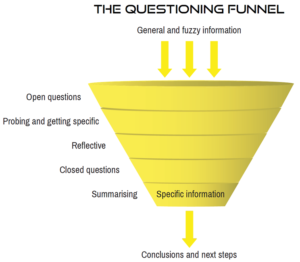
Questions for active listening

People will then start to tell us things, (and there’s a whole process around that which I think is another conversation), but an important part of getting the solution right is getting the requirement right. While that’s not so difficult, there’s a level of sophistication and expertise needed to elicit that accurately. Very often, one individual doesn’t know what all of the requirement actually is, or has a view that not everybody shares. So we look at how to come to a collective consensus that fits everybody.”

Nina says “I would add ‘listen to understand’. Because, as well as asking probing questions, it’s about asking enough questions. So, the client might think it’s a surface problem, ‘oh, I just need to fix this problem,’ but the skill is in digging deeper to really understand what the problem is and what’s causing what they think is the issue.”

“And I would add one more thing” says Heather. “Obviously, it’s important to have robustness and rigour, but also to be flexible. Sometimes we find that we’ve done all our wonderful robustness and rigour and then after maybe the second session, new things emerge. It is about being observant and staying curious. The solution can invariably change, because change happens so quickly in an organisation that we have to be flexible and adaptable as part of that process as well.” 

“I think it’s actually really good and healthy to say, ‘this will change, let’s not set it in stone,” says Bradley. “Because ultimately things will change as we go through the programmes and interventions. That’s been my experience – it never stays the same, ever.”


What other considerations do you come across?

“Time is often an issue,” says Bradley. “People are really busy, but it’s important for us to refine the requirement and complete the initial piece of work so that we can start the development and intervention delivery. But clients have their day jobs and priorities to manage. So encouraging people to carve out the time for what we need can be a challenge. And sometimes their expectation around the time needed to develop and then deliver a programme is unrealistic. Because it’s our professional world, we’re very aware of how tight time already is. But when people aren’t giving us what we need internally to get going, that can cause difficulties.”

How do you select the theories and methodologies that will suit the client, issue and desired solution?

“That’s a question for Heather,” says Bradley, “because she done some good work around this, and people have really enjoyed what she’s selected and delivered.”

“It is handy to have a background in learning development, as well as being a consultant,” Heather replies, “because there is a process, and having that core basic knowledge of what actually helps people make behavioural change is really important. That toolkit, plus lived experience and wisdom, is the foundation piece.

The next piece is using the analysis. Then we bring our lived experience and wisdom into the client’s world and find the sweet spot. Next we offer ideas based on considerations they’ve told us around time, budget, global reach, etc. Then, at the simplest level, we provide one to three options.”

“One thing I’d add to that, “says Nina, “is that we start with the end in mind. Once we know what we’re aiming for, that will inform our approach. So for instance, if you were a global company and it wasn’t possible to get everyone together, we might need to incorporate more e-learning, and videos. And we would have to think about the different elements and steps in the journey to decide which would deliver the best outcome.”

Bradley agrees: “Yes, and I’d reiterate the importance of having that background and experience. There are certain business models and concepts that just tend to work for the majority and resonate strongly for participants. More specifically, there are a number of models that I have experienced people’s reaction to many times around leadership, or change, or whatever the subject is. This is a great help too.”

“I’d say working in partnership with the client is also incredibly important,” says Heather. “So you’re not seen as some sort of bolt-on outsiders. It’s about working with them, engaging them every step of the process, so they understand the content and are living and breathing it, and they get a sense of what you’re doing.”

“They generally have other things going on in the business,” continued Bradley “and might already be applying a certain methodology. For example, at the moment I’m working with a company who are talking about ‘finding more zebras’. A zebra being your ideal client, because they look like a zebra. So if they were using that sort of terminology, that would probably influence how we come in off the back of that.”

What happens if an organisation is already applying a methodology, but you don’t think it will deliver the right outcome?

“That does come up!” says Bradley. “If a client is utilising something already, we can of course incorporate that if they want us to. We wouldn’t presume that we know better than the client about their own business. So we certainly incorporate what is being used but we will also bring new light to any given situation including new materials and insights.”

“We would also ask questions to understand their reasoning, and how we might add value to the broader solution,” adds Nina.

“We might ask them to tell us about some success they have had with it’,” adds Heather. “And then try to build on that success.”

How do MatchFit measure the effectiveness of the programme?

Bradley explains: “Measurement is essential for us at MatchFit, and we do it on four levels, five if the client allows:

  1. Reaction – How do people respond to what we’re doing? Are they finding it valuable? Are they enjoying it?
  2. Learning – What new insights are they gaining by taking part?
  3. Behaviour – What are they changing, what have they done differently based on those insights?
  4. Impact – Having done something differently, what is the result of that changed behaviour?

And then the fifth level, if they can share the information, is ‘What is the monetary value of that change? What has actually been saved, or made financially?

For example, one client has saved over £120,000 pounds on average for each unit the intervention was rolled out in, because the leadership really engaged in the programmes and learned not only that it was important to manage things differently, but how to do so.

We’ve earned so much credibility with clients by being able to measure outcomes. There’s a lot of learning and development that people go on that isn’t measured at all, and I honestly believe that’s a waste of budget.”

What is MatchFit’s top tips for designing a really great programme?

  • You don’t get a degree in one day. So invest in programmes not training days.
  • Support people in committing the time for their development.
  • Make sure your consultant communicates well, is open to different ideas and asks sufficient questions to really understand the problem. Are they really listening?
  • The best interventions have reflection time built in. People are so busy, and have such a lot going on, they need to have time to sit quietly with the content and look at it to build results.
  • Does the programme include wellbeing support? Learning and doing new things creates stress (positive stress) in the body, so wellness support woven in helps people bring their very best self all the way through.
  • Does the programme have plenty of interaction? Does it get people involved in what they are learning so that they can practice the skills?
  • How will it be measured?

Bradley concludes, “It’s really important to MatchFit that we work in partnership with a client and get to know the senior team, because we’re there to facilitate positive change. We’re not just flying in and flying out to supply a service. We need to engage the senior leadership team, because even if they’re not coming on the intervention, they need to be aware of what the intervention involves. When we step away, they’re the people who are going to continue embedding those new skills and behaviours. That’s how we set them up for success.”

To learn more about the MatchFit CLIMB interventions, please visit the website https://matchfitclimb.com/climb-interventions/

If you’d like to learn more about our MatchFit programmes, take a look at our information pages here, or why not get in touch? enquiries@matchfitwith.com or call +44 (0) 7858 775 249

Bridging the Gap – A Conversation about Designing Interventions Read More »

Can we talk about it? Reframing difficult conversations, with Garin Allen

In the realm of professional interactions, difficult conversations are inevitable. In this article, Garin Allen, an HR Technical Consultant with extensive experience in the Civil Service HR Casework and Technical Consultancy  team, sheds light on the transformative power of reframing these challenging dialogues.

With a background as an HR Case Manager, Garin’s journey within the Civil Service spans seven years. Over this time, he has witnessed substantial changes, with increasing numbers of clients engaging with HR Technical Consultancy (HRTC) service. These changes, Garin offers, have been driven by a combination of factors, but one significant catalyst has been the Civil Service HR Casework and Technical Consultancy  team partnership with MatchFit – the HRTC.

“Things have changed massively since I started all that time ago”, he says. “More Clients have come on board looking to plug those gaps in their technical capabilities. When you see cases coming in time and again, by addressing capabilities and making managers more confident in their ability to deal with issues, you can reduce the number of cases.”

What has driven this change?

“I think the partnership with MatchFit has helped support the development of the HRTC” Garin says. “But in terms of why the change has happened, I think that as a public sector body, the casework around attendance and other issues is a significant cost. We need to be able to deliver services,  if people are off sick, we need to ensure we’re resolving the root cause.

The Civil Service is huge, so there has been a lot to change over the last couple of years. But working with the prisons particularly, as we do with our Enhanced Service, it has very much been a case of deeply understanding the underlying issues and asking ‘How can our prisons, our public sector departments, deliver great service for the public that we serve?’ We can’t do that until we get managers capable of managing people in a way that improves attendance, for instance.”

The issue highlighted by Garin is one that plagues many organisations – the lack of managerial skills. He passionately advocates for providing line managers with essential soft skills training, emphasising the importance of setting up leaders for success in managing their teams effectively.

“I’ve often found that people have been promoted into a managerial position without receiving important soft skills training”, he says. “Despite the fact that there are people reporting to you, and you have the ability to shape someone’s life and career, it can be a very neglected area of your management journey. It’s useful to learn by making mistakes, but it’s not appropriate to learn from those mistakes at the expense of others. Making those same mistakes time and again can result in a reduction of morale, and people leaving, which is a great waste of talent.”

“I’m quite passionate about this – how do you step up from being one of the team one day, to running the team the next?  We need to upskill people so that they’re set up for success from the start and can lead their team effectively, delivering a great service to our public.”

On paper, this is all very fixable – all it actually takes is for somebody to be steered in the right direction; asking the right questions of themselves and understanding how to use that information; how it all fits together. But clearly, in practise, it’s much more complex than this.

“If you consider that there are thousands of managers across the Ministry of Justice and across the Civil Service as a whole”, Garin reflects, “the reality is that if I select five managers to train, that’s a tiny pool. So we have to look at how we scale this up.  When we see civil action cases coming through, we need to be asking what can we do to remedy that? Could better line-management have prevented the absence? Could the absence have been managed better in terms of getting the person back to work? It’s a dual pronged approach.

When we look at the prisons, our priority is to reduce reoffending and protect the public. How do we do that if we don’t have the staff on the landings to support the prisoners? This is a situation that can spiral, as if there aren’t enough staff, that puts more pressure on the ones that are there, which increases absence due to sick leave.”

Addressing the challenge

The HRTC partnership has developed a number of modular interventions that can be selected according to the analysis and recommendations made at the start of the HRTC Service.

Garin explains: “We perform an Analysis every time we work with a different client, and then suggest the key areas that we can really support with. We look at what the survey is telling us in terms of the culture and what the one-to-ones are telling us when we’re talking to the twelve selected people across the organisation. We look at the HR case audit to understand the nature of HR cases. All this information combines to help us decide which five or six interventions we should pick, and why? The common topic though is communication – it’s what we all do every single day. As an HR Case Manager back in the day, I would ask ‘have you had that conversation with Person X around expectations?’ And so often the response was, ‘no, I assumed they would know.’

People are communicating all the time, and if we don’t get that right, then nothing else can easily follow. That’s why the ‘Reframing Conversations’ intervention is so popular.”

Why is this so useful?

Garin explains: “Conversations form part of our everyday. Every time we have a conversation with somebody, we’re getting something out of it. So this intervention looks at ‘how do I get the best out of those conversations? How can I approach a difficult conversation well, rather than putting it off?  What is my conversation style; what are the styles of my team members?’

We look at elements such as avoidant tendencies – I’ve certainly been there in the past! Then you have the bulldozers who will say anything, without thinking through the consequences. You have the peacekeepers, trying to find the balanced approach everywhere. And then you have those individuals who really have nailed the dialogues; the professional communicators that can get the best out of a conversation – by active listening, essentially.

The really important part of that intervention is where we focus on ‘Five conversations, one at a time’, based around the book by Cowley and Purse. We look at how we can build for the future, set expectations with our teams and build trusting relationships. For me, this is that ‘penny drop’ moment in the intervention, when people realise that ‘these conversations really are important, and here’s why’.”

Garin mentions that Reframing Conversations also dovetails nicely into another, called CLIMB 360 Feedback, which focuses on actively extending, soliciting and receiving effective feedback. When giving feedback, how do you frame it in their conversation style, so that it actually lands with that person? He says: “Others that work well around it as well are the coaching modules; looking at having coaching conversations with your direct reports. They work really nicely together because again, the coaching approach allows you to have a conversation that you build around trust, and then develop really targeted actions that address clearly defined  issues.”

The impact in practice

“One standout example of a successful intervention that comes to mind, where I could really tangibly see the improvement,” Garin recounts, “is one that will sit with me forever. I delivered ‘Reframing Conversations’ in a prison environment to a Custodial Manager. I would say she was probably quite shy, and she was very unsure of herself. She was actually very good at her job, but her confidence just wasn’t there. When I came back a few months later, and asked how things were going, she said that as a result of the intervention she had been able to challenge the Governor over a decision she disagreed with, which she would never have done before. The skills she learned as part of the intervention enabled her to get her point across, earn the respect of the Governor (who took her points on board) opened the door to future fruitful conversations.”

Why does the HRTC Partnership work so well?

“The MatchFit partnership with us works well for many reasons.” Garin explains. “Having an external consultancy approach helps us see how we can do things better. But even more important is that we work really collaboratively, it’s a partnership that is seamless – our clients see us as one entity.

MatchFit also has a very phenomenological approach, which makes the programmes and interventions truly relevant to people. Rather than just throwing theory at participants, it’s all linked back to their workplace with practical hints and tips for how they can use it.

Ultimately, conversations are the things we do every day. They’re the chance to get things right; they’re also the times when things can go drastically wrong. So getting these conversations right, having them frequently and building trust in the workplace, is so important. This is why these interventions go down so well with the people we work with, as they can see how they link back to the organisation and how they can use it. Rather than leaving the workshops with lots of information but wondering ‘how am I going to implement this?’, people have gained an understanding of how they work, how their team works, and how the organisation works. But most importantly, how they can implement the actions both immediately, and on an ongoing basis.

The bottom line is that if you get the conversations right, other things will fall into place as a result of it.

Garin’s Top Tips for Managing Conversations

  • It’s essential to build trust – without it, you’re not going to build for the future.
  • Develop active listening skills, without bias or judgement.
  • Find out about your team – what makes them tick?
  • What’s their life like outside of work?
  • How do they want to be communicated with; how do I want to be communicated with?

Recommended Reading

To further delve into the subject, Garin recommends the book ‘5 Conversations: How to transform trust, engagement and performance at work‘ by Nick Cowley and Nigel Purse

To learn more about the MatchFit CLIMB interventions, please visit the website https://matchfitclimb.com/climb-interventions/

If you’d like to learn more about our MatchFit programmes, take a look at our information pages here, or why not get in touch? enquiries@matchfitwith.com or call +44 (0) 7858 775 249

Can we talk about it? Reframing difficult conversations, with Garin Allen Read More »

When absence masquerades as sickness: A MatchFit perspective

By Bradley Honnor

It’s a fact of life that people get sick. And as employers, we have a duty of care to ensure that the terms and conditions of employment look after people’s wellbeing; that they don’t feel pressurised into coming to work when they’re unwell. How well we support them is a reflection of the organisational culture.

But it’s important to differentiate between genuine sickness absence, and absence in general, as the latter is often a manifestation of a deeper issue. Managing sickness absence is the straightforward one to deal with, as long as there is a robust policy in place, which is well communicated. Where things get more complicated, is when the absence is not a direct result of ill-health – and this is where we find that a lot of organisations and managers are not dealing with the issue very well.

Often it can be the elephant in the room – everyone in the team knows that the individual is off again, but the leadership is not dealing with the problem. And that has an impact on the culture of the organisation. It makes people feel frustrated that they’re doing the extra work, and taking the responsibility of the people that are off, and the resentment builds.

Not managing that effectively can lead to a negative feedback loop. A company might start off being very sympathetic and supportive of absence, but then when this is taken advantage of, they become less supportive. Then the genuinely sick are impacted and it spirals from there.

We’ve worked with an organisation that had exactly this problem. When new starters joined, they were told in their induction that they’d get their 25 days holiday pay, but 10 days sick leave as well.   So those 10 days were assumed to be part of the annual leave entitlements. It became an acceptable norm because everybody did it. On some days, 50% of the staff were off! Imagine the impact that was having on the remaining staff.

The impacts of absence

The most obvious impact of a high degree of staff absence is reduced productivity. When staff are absent, productivity often dips. Tasks get delayed, and it’s a real challenge to keep things moving smoothly. Coupled with this, the workload for others increases. Team members end up shouldering extra responsibilities. It’s tough on them and can lead to burnout. Customer service can take a hit. Reduced staff means slower response times and potentially unhappy customers.

This in turn leads to problems with morale. Frequent absences can really dampen team spirit. It’s something we’ve seen first-hand, and it’s a delicate issue to manage.

There’s a direct financial impact too. Covering overtime or bringing in temp staff isn’t cheap, and it adds up. Workflow and project timelines suffer. Delays become common, and it disrupts the rhythm that teams and organisations work hard to establish.

From a management perspective, it’s a real headache. It’s time-consuming and stressful to keep reorganising work schedules, and the quality of work can drop. Staff covering for others might not always match the usual standards, or have the time to do the jobs thoroughly, cutting corners just to get them done.

Ultimately, over time, business reputation suffers, especially as service levels drop.

So why is absence frequently not addressed?

In some workplace cultures, a certain level of absenteeism is almost accepted – changing this mindset is challenging. Often, absenteeism stems from deeper issues, like workplace dissatisfaction, but the root causes can be overlooked. Addressing the symptoms, not the cause, is a common mistake. But without good monitoring systems, it can be hard to spot and address patterns in absenteeism effectively.

Often, the problem is simply a lack of training. Many leaders aren’t trained in handling the formal processes of absenteeism, and often aren’t even aware of the support framework that, for instance, ACAS offers. It’s a gap in management skills that MatchFit often encounter, but it’s actually very straightforward to rectify.

More complex is the issue of avoiding confrontation. Confronting absenteeism means tough conversations, and some managers shy away from this to avoid conflict. However, this can also be addressed with the appropriate training to give managers skills and confidence in this area. An additional outcome that we often witness is that the manager finds their new skills empowering. They start to enjoy this part of their role more, because being able to have tricky but trust-based conversations has further, positive ramifications for developing high-performing teams.

It’s not unusual for a fear of legal repercussions to paralyse decision-making. Without clear policies, it’s tough to tackle absenteeism. MatchFit have worked in organisations where this has been a significant barrier. This might due to a lack of resources such as HR support, which can make managing absenteeism seem daunting.

Sometimes, however, managers simply underestimate the impact. They see it as a minor issue and don’t realise how much absenteeism is affecting their team. Managers are busy, and dealing with the issue falls by the wayside due to other pressing tasks.

So what can be done?

Firstly, how well do the HR policies and procedures stack up? Are they regularly reviewed and updated? Is the HR department fully-versed in ACAS guidelines and law?

Then, how well is this communicated? Does every manager know how and where to access support and information? If they’re not accessing it, why not?

Where gaps are identified, outsourcing to a consultancy such as MatchFit can save an organisation a great deal of money. For example, we were able to save one client £120,000, simply by training them to manage their absence effectively!

There are many fears and misconceptions around tackling absenteeism. But if the appropriate support is in place and the processes are followed correctly, then it need not be the costly headache it often becomes.

If you’d like to learn more about our MatchFit programmes, take a look at our information pages here, or why not get in touch? enquiries@matchfitwith.com

When absence masquerades as sickness: A MatchFit perspective Read More »

The what and the why of CLIMB 360 Analysis

By Bradley Honnor

Creating and sustaining a culture of high-performance whilst ensuring an inclusive environment of diversity of thought and background can be challenging for organisations to navigate. MatchFit have always believed passionately that the key to solving this dilemma is a thorough understanding of an organisation from all perspectives, which is why every programme we deliver begins with a CLIMB 360 Analysis.

But what is CLIMB 360 Analysis, and how does it impact the outcomes for clients? One example is evidenced by our partnership with the Civil Service HR Casework team to form the multiple award-winning HR Technical Consultancy (HRTC), which uses CLIMB and other MatchFit products as an essential element of its service.

Why CLIMB 360 Analysis?

Fundamentally, the goal of CLIMB 360 Analysis is to thoroughly understand the perceptions of individuals that work within a business or a team. It seeks to deeply understand individual perspectives, for example, what it’s like to work there and how it feels. It asks for people’s views on communication, leadership and the culture, and seeks to obtain a thorough sense of what staff feel is working and what needs to change in order to make the culture, leadership and communication more effective.

We always start with the CLIMB 360 Analysis process because we cannot and should not assume that we know and understand exactly what needs to be addressed; that the priorities are the right ones. How can we take a team or organisation to the next level of performance without actually speaking to the people that work in it and understanding their current perspectives and challenges? Quite often, one outcome of the analysis is that the commissioning leadership will have some of their beliefs and expectations confirmed. But equally, there are often surprises; insights that they were not expecting at all.  

Seeking perspectives

For a programme to be effective, we can’t just rely on leadership to commission the work – we need to seek the perspectives of others in the organisation, with whom we conduct confidential, one-to-one conversations via our skilled consultants. To solicit the widest range of views possible, we ask the leadership team to select 12 diverse people. We request that this includes staff at different levels of seniority; maybe who have just joined the organisation and those who have been there a long time. We ask for diverse backgrounds and identities to be represented. And we specifically ask for the ‘disgruntled and the evangelical’.

Because confidentiality is ensured throughout the process (and the fact that we are an external organisation) people feel safe to speak openly and honestly. This means we gather a really broad range of views and opinions around specific questions that are non-directive and non-leading. What emerges from these conversations is the discovery of what people are actually thinking; what’s on their minds. We see themes emerging and the real issues that everyone is talking about. This way, we can identify the challenges that need to be overcome, and the elements that are working and need to be reinforced.

Views in tandem

Alongside the CLIMB 360 Analysis, HRTC run a bespoke organisation-wide survey which reflects very similar questions. We then compare the CLIMB analysis responses with the survey.

In addition, a skilled HR case management audit is conducted. This is where an HR Case Manager sits with management and examines every outstanding HR case – for example, every grievance, every disciplinary, past and present. They look at how quickly and professionally past cases have been concluded, the outcomes and how best to resolve the outstanding current cases. The objective is to provide a strategy which supports managers and leadership to conclude the cases professionally; to recognise what’s worked before, and take into account their risk appetite in terms of resolution. The case manager can then advise how to progress the case.

These three elements run together to provide what we term ‘Cultural Immersion’. Collectively, they allow us to achieve a genuine insight into how the organisation is really operating. This information is then fed back to the leadership in the form of a full report that outlines (anonymously) the themes drawn from the conversations that will result in better leadership and management, and move the needle in terms of organisational high performance.

MatchFit have always worked in this way because we have a deep-seated belief in the importance of getting underneath the surface, behind the scenes of what’s going on in an organisation. This is also a reason why the HRTC partnership works so well, because SC HR Casework have a similar passion for evidence-based practice.

Measuring outcomes

This approach makes a huge difference to overall outcomes, because in the report, we can specify what the focus of actions should be and what outcomes can be expected. From that analysis, we’re able to benchmark and measure the process moving forward. There’s a stake in the ground stating ‘this is where you started, this is what we’re doing, and this is the change needed’. The leadership can then priorities and shape their own direction for progress. Not only can we then look back at the end of the programme and ask if we were successful – we can also adjust as required during the journey. This ability to measure is invaluable.

As the programme itself progresses we actually measure at four different levels. We measure how people are reacting – are they finding value in the process? We measure what they have learned – what insights have they gained that they didn’t have before they engaged in the process? And we measure behaviour – what have they been doing differently based on what they’ve learned? Finally, we measure what the impact is on the organisation of doing things differently.

We tend to find evidence for the first three levels via the CLIMB 360 Analysis, HR bespoke survey and Case management audit. When we, as HRTC, conduct this Cultural Immersion and feed the analysis report back to the leadership team, we can identify whether there’s value in the process; is this information useful? Are you gaining insights? Did you know this already? Is this new to you? What are you learning about your own organisation?

We can then advise what they need start thinking about as the programme moves forward: what are the priorities for doing things differently, what are the interventions that are needed to effect change. The analysis helps us to not only identify the dimension of the CLIMB programme, but also helps us identify the interventions to be delivered.

Collaborative working

Throughout the programme, we’re not only working with people individually, we’re working with them as a group. We really get to understand them, and their challenges. That might be, for example, a manager talking about the need to upskill their own team in certain areas. So the process by definition, also uncovers areas that need additional input.

Because we work through and wholly in partnership, the access to data and material we can use to benchmark and evidence each programme’s success is unprecedented. If MatchFit was just a supplier, we wouldn’t have access to that confidential information. But because we’re working in partnership, we work together to demonstrate the success of the CLIMB programme.

Even from stage one of the CLIMB programme, we can start to see a positive impact on an organisation. For example, a disciplinary might historically have taken 18 months to conclude, whereas now it only takes seven months, because the managers have been upskilled through the HRTC technical interventions.

Being able to measure the impact so clearly is unusual. And it’s a key reason the HRTC partnership is award-winning – because we can visibly demonstrate the path towards high performance.

If you’d like to learn more about our MatchFit programmes, take a look at our information pages here, or why not get in touch? enquiries@matchfitwith.com

The what and the why of CLIMB 360 Analysis Read More »

Motivation Part II: Igniting Intrinsic Motivation: A Leadership Imperative

In our previous article, we looked at the importance of making a self-motivation a strategy, and how to build habits around this area of self-development. Here, we’ll delve into the dynamics of motivation, the role of company culture, and strategies for igniting intrinsic motivation in your team.

Extrinsic motivation is a fundamental of leadership – addressing Maslow’s Hierarchy of Needs, such as salary, conditions, bonus, rewards, recognition, showing people they are valued. These external factors can drive performance and satisfaction to a certain extent. However, it’s crucial to recognise that they are not the sole drivers of sustained motivation. To drive actualisation and high-performance, igniting intrinsic motivation in others is key – providing people with a sense of purpose, autonomy and an opportunity for mastery.

People need to feel that they count; that they are doing a great job, are adding value, are making a difference. They need to feel challenged, stretched, that they’re developing. All these elements come from within but may need a leader to blow on the embers and ignite the fire of self-motivation.

But motivating others in the workplace can be a formidable challenge, and leaders often find themselves grappling with a lack of motivation among their teams. Understanding the root causes and knowing how to overcome them can make all the difference.

The part that culture has to play

A strong organisational culture fosters a sense of belonging, purpose, and shared values. When employees resonate with the culture, they are more likely to be self-motivated. However, it’s important that leaders don’t take a strong culture for granted – assuming that everyone is on the same page can lead to disenchantment. A leadership that cultivates collaboration, innovation, personal growth, keeps asking questions of its employees—and listening to the answers—fuels intrinsic motivation.

Pushing through when everyone is ‘stuck’

There will often be situations where teams feel stuck or demotivated. During these times, it’s essential to trust the team to find their own way forward. Encouraging people to take ownership, show belief in their abilities, and assigning challenging tasks that stretch their potential will help them grow and gain confidence. But it’s also important to support employees on their ‘stretch’, not just dump tasks on them and let them struggle.

Making group habits

Building group habits can be a powerful motivator. As we explored in the last article, making motivation a strategy, developing consequential thinking and defining aligned goals are powerful tools for building successful inherent responses to challenges. Establishing routines that promote teamwork, creativity, and self-improvement, and regularly reinforcing these habits creates a culture of continuous improvement.

Be kind – but don’t be afraid to challenge thinking

Becoming really good at offering great feedback is a key skill for leaders. Treating employees as human beings with feelings and their own phenomenology is obviously fundamental. But ultimately, nobody gains from not addressing areas for improvement, which left, can start to impact other members of the team, as well as the employee’s own intrinsic motivation.

Top Tips

While extrinsic motivation has its place, true leadership excellence is about igniting the motivation that lies within each team member. By understanding the contributory factors, nurturing a positive culture, and applying effective leadership strategies, you can inspire your team to sustainable high-performance and drive organisational success.

  • Trust people to do things their way.
  • Show unwavering belief in your team and assign tasks that stretch their abilities.
  • Offer support during their growth journeys; don’t leave them to struggle alone.
  • Be kind and recognise their efforts and achievements.
  • Challenge their thinking and self-belief when necessary to foster personal growth.

If you’d like to learn more about our MatchFit programmes around motivation, take a look at our information pages here, or why not get in touch? enquiries@matchfitwith.com

You can read Part I here

Motivation Part II: Igniting Intrinsic Motivation: A Leadership Imperative Read More »

The Value of Experience in Navigating Complex Challenges: A Personal Journey with MatchFit

An interview with Catharine Brooks

When the world was plunged into uncertainty with the onset of the COVID-19 pandemic in early 2020, businesses and individuals alike faced a new reality. It was a time when adaptability and innovation became paramount, and for Catharine Brooks, it marked the beginning of her journey as a consultant with MatchFit.

Highly experienced, Catharine has always thrived on the dynamic interaction with clients. But as the pandemic struck, the landscape of her work shifted from physical, ‘in the room’ interventions, to virtual. One of her first experiences of virtual training was quite unique – she found herself working with the nation’s elite footballers, the England Lionesses. “It was an absolute privilege as well as being a real test,” she admits, “I am a huge football fan myself, and found myself working with these athletes who have achieved so much!” The experience exemplified the adaptability and resourcefulness required to deal with increasingly complex challenges. Through Women in Football, Catharine now has the exciting opportunity of working with the FA and the Premier League.

As a MatchFit partner, Catharine provides services and support that effect tangible changes to the lives of clients, their teams, and the organisations they operate within. When asked what she brings to the role, Catharine’s response is unequivocal: “I have over 35 years’ experience in corporate and cultural change, leadership and personal skills development, and executive coaching. I’ve worked across various sectors, including public and private, working with leading global organisations and FTSE 100 companies.”

But regardless of the organisation, it all comes down to people and personal development. “Personal development is exactly what it says – personal,” she continues. “I love that moment when an individual’s lightbulb switches on. You can sense, in that moment, they have taken their first step on their personal journey of new insights, reflective practice, and meaningful feedback.”

Catharine practises a strength-based and action-focused approach to both leadership and personal development. Being a certified Strengths Coach, as well as an Emotional Intelligence Coach, she encourages and supports leaders to identify strategies to get the best from themselves and their teams.  When asked what makes a great leader, she stresses: “Possessing a growth mindset, understanding and regulating emotions, demonstrating the right behaviours, and playing to strengths are at the very core”.

Her ethos for creating inspirational and servant leadership is simple: “My job is to help leaders find their spark and discover ways to share their passion, knowledge, and experience with their teams and across the business. Their job is to go out there, be themselves, and to grow and develop themselves, their teams, and their organisation.”

The programmes created and delivered by Catharine and MatchFit focus on giving compassionate, strengths-based feedback and coaching alongside interventions to deliver new understanding, simple strategies, and practical tips to successfully deal with phenomenological challenges and opportunities. Leaders who have worked with Catharine report having gained significantly higher confidence in their ability to lead themselves and others.

Catharine’s work with HMPPS and several leadership teams in a variety of HMP prisons highlights the transformative power of MatchFit’s CLIMB programme. In fact, with the programme’s support, the Civil Service HR Casework team recently won the award for best talent management initiative at the CIPD Awards 2023.

In an extremely challenging environment that lacks resources and faces high staff turnover, the CLIMB programme focuses on engagement, communication, problem-solving, and leadership. It creates a safe space for leaders to reflect on what matters to them in the present and how they can make a difference, even in small ways, to the future. “It’s about committing to small, meaningful actions,” Catharine emphasises. “If they can make a one percent change, it’s the first step. Then they can look to take their next step. It’s simply the aggregation of marginal gains.”

This philosophy underpins the importance of incremental progress when dealing with complex challenges. Creating a safe space for individuals to reflect, share their thoughts, show vulnerability, and commit to actions, is imperative.

“This is often the first opportunity for many of these leaders, and they find it both cathartic and rewarding.” As facilitators, Catharine and her fellow associate consultants at MatchFit assume roles that blend coaching and mentoring. They ask probing questions, share practical strategies, and challenge participants to carefully consider their decisions. This approach harnesses the power of collective small changes, which, when combined, yield significant impacts.

But success in this field isn’t just about tactics and strategies; it’s also about trust and communication. MatchFit has cultivated an outstanding reputation within the Ministry of Justice and the wider Civil Service. “Our clients trust us, which is so important,” Catharine acknowledges.  A poignant moment from her work with prison staff encapsulates the impact of trust. One individual told Catharine, “When you first came here, a lot of us were very sceptical; you said we could trust you, and you had our best interests at heart. Having worked with you over the past six months, you were right, and you’ll never know how much that means to us.” Feedback like this reaffirms the profound difference MatchFit makes in the lives of its clients.

Outside of her demanding role at MatchFit, Catharine balances running a successful personal leadership consultancy business. She enjoys travelling (her next trip being to China to visit her daughter, who us currently studying in Beijing), going to the gym, long country walks with her dog, and relishes good food and wine with family and friends. Mindfulness also plays a crucial role in maintaining a positive work-life balance, reminding us of that even in the pursuit of helping others navigate complex challenges, taking care of oneself is equally important.

In a world fraught with ever-evolving complexities, Catharine Brooks and MatchFit exemplify the invaluable role of experience, adaptability, and trust in guiding clients through the most challenging of journeys. As she continues to make a difference, both in the boardroom and at grass roots, Catharine’s unwavering commitment to positive change is a testament to the power of experience in a rapidly changing world.

The Value of Experience in Navigating Complex Challenges: A Personal Journey with MatchFit Read More »

From bonding to action – making a team ‘Match Fit’

Jean-Pierre Beneche, Executive Director of global financial services group Julius Baer, explains how MatchFit’s ‘Building Teams’ programme delivered tangible results in creating and establishing a highly-effective specialised team.  

Headquartered in Switzerland, and with a presence in the UK, Julius Baer is a global private wealth management company, specialising in supporting the financial needs of high-net-worth individuals. Jean-Pierre’s team reports into the Chief Risk Officer and was created to ensure the efficient and compliant handling of data connected to the organisation’s activities.

Building a new team, understanding the challenge

Jean-Pierre’s had the task of rapidly building a new team capable of quickly delivering on a clear vision. Following the team’s formation in September 2022, MatchFit came in to offer guidance and ensure the group would develop in the most effective way.

“I was new to a role that required building and leading a new team, who were quite diverse in their levels of experience and specialities. A key factor in my successful leadership would be finding ways to get them to work together effectively as a team. I was also mindful of the pressure I can put myself under to constantly deliver high standards. Having discussed the challenges with our HR department it was suggested we work with MatchFit, an organisation that had delivered good results for other teams in the past,” he explained.

MatchFit ‘Building Teams’ module

Having analysed the challenge with MatchFit, it was decided that their ‘Building Teams’ module was the most appropriate programme to achieve the required outcomes.

Jean-Pierre wanted to create a core vision for the department and motivate the team. Given the different role profiles and levels of experience, it was key that everyone came together early in the process, to ensure they could see how their roles fitted into the team and how the group could become as efficient as possible.

“There was an important pre-phase before the group came together,” he explains. “Individually, we had one-to-ones with [MatchFit managing director] Bradley, where we explored a range of issues. We joked about what we might have said in these sessions and that in itself allowed us to start bonding more as a group.

“Expectation was building before we met as a group for the first time around what was going to come out of the process. It became a recurring topic of conversation. I didn’t need to proactively remind the team that the group session was going to happen. I thought that was fantastic,” said Jean-Pierre.

After the first group meeting, the group took the view that they needed to digest what had been discussed and Jean-Pierre followed up with group and individual conversations about the output and what it meant for the team.

Making a real and immediate impact

There were immediate tangible signs that the programme was working.

“Naturally I expected the programme to help but it actually contributed to the enhanced performance of my team in a very short period of time. It definitely helped me individually and I have to say I was not necessarily expecting it to be so helpful,” said Jean-Pierre.

The dynamic around the programme really engaged the team who discussed it throughout the three-week process and took bets on what the next session would focus on. “It really became a ‘thing’, which added to the team bonding process,” added Jean-Pierre.

He continued: “I think what this has really, truly, created is an awareness of our strengths and weaknesses as a group. That was one of the main outcomes: the understanding that we need to be aware of these as a team, because there’s nothing worse than being blind to them.”

The programme has helped Jean-Pierre understand you cannot just get on with your day-to-day operations without taking the time to step back and reflect. “And the MatchFit sessions allowed, and even forced, us to do this”, he said.

The sessions proactively helped Jean-Pierre and his team take action to be more efficient with regular discussion around things the group could do to achieve this.

“It’s easy to say that you need to improve in certain areas but then just carry on with your day job. The programme forced us to stop, take a pause and decide: okay, out of the 10 things that we said we potentially wanted to do, we’re going to focus on two or three, actually do those, and assign responsibilities. We also understood we needed to make sure we stay accountable around those decisions.”

Tangible changes

He continued: “I’m especially proud that we didn’t just close the door after the session and say, ‘let’s see what’s going on in six, eight weeks’ and then take no action. We really stepped up to the mark and made the changes we said we would.

It was one of the first comments in the second session. Michael [Brooke, MatchFit consultant] and Bradley really challenged us. It is normally the moment in a programme when everybody’s looking at each other, because nobody has actually done any of what they said they would. But my team all stood up and said, ‘no we have done things. Things have changed. We’ve really been active around what we discussed’. And that’s something that I really liked.”

When the programme finished, the team documented the actions they still felt they should focus on.  

“My team has been very, I’m going to say, aggressive in taking action, but in a positive way.” He continues: “MatchFit created energy around the determination to make us a successful team. It has definitely created a bond around the desire for excellence that this team wants to be recognised for; it’s become a shared goal.”

A new viewpoint

“I would definitely encourage anybody to embark on this programme, which can be done at any stage in your team’s lifecycle.

As a middle or senior manager, you may think that you already have the necessary knowledge and experience and you know what is best. But it is very, very helpful to have support to lead you through such a programme and help you take the very the best from it.

Different elements of the programme will resonate more strongly with people, but as a team, we have gained invaluable takeaways and made great strides forward.” He concludes.

From bonding to action – making a team ‘Match Fit’ Read More »