
Bradley Honnor, Managing Director of MatchFit, shares his perspective on what really happens inside organisations when a CEO departs — and why the greatest risk is often not strategic, but human.
Across global politics, we’re witnessing what happens when long-standing leaders are removed or step aside in regions such as the Middle East and South America.
In each case, the immediate questions are strikingly similar:
Who now holds authority?
Is there a credible succession plan?
Will direction change?
Is the system stronger than the individual who led it?
Markets respond. Citizens react. Alliances recalibrate. Confidence shifts based on perceived stability.
The context is vastly different from corporate life, but the underlying dynamics are not.
When a CEO or Managing Director resigns, is removed, or steps down unexpectedly, organisations experience their own version of this shockwave. Governance processes are activated, the Board convenes and statements are drafted.
But inside the organisation, something else happens first. People react.
And that reaction — not the formal transition plan — will determine whether performance stabilises or slips.
The Psychological Shockwave
For employees, leadership departure is rarely interpreted as a neutral event.
The sort of questions I’ve seen surface quickly are:
- Is the strategy changing?
- Is my role secure?
- Who really has authority now?
- What aren’t we being told?
Uncertainty tends to shift energy away from performance and towards self-protection.
Decision-making often slows, informal narratives accelerate and discretionary effort declines.
If communication is delayed, the vacuum fills itself.
Therefore, for HR Directors, this is the critical window.
Executive Team Instability
At the senior level, the dynamics are different but equally fragile. Power recalibrates, alliances form and decision rights become ambiguous.
Without deliberate alignment, executive teams can fragment at precisely the moment cohesion is most needed.
From a CEO or interim leader perspective, the priorities are clear:
- Establish authority without ego
- Clarify decision-making structures
- Align on 3–5 non-negotiable performance priorities
- Maintain operational discipline
From a Board perspective, visibility and credibility matter most:
- Demonstrate governance strength
- Communicate clearly with investors and stakeholders
- Signal continuity of purpose and values
But internally, the organisation is watching behaviour more than statements.
The Cultural Risk and Trust Factor
Globally, CEO departures have reached record levels, in 2025 — 21% above the 8-year average*. This trend underscores how common leadership transitions have become and why organisations must be prepared.
In my experience, leadership transitions often expose pre-existing fault lines.
If trust was fragile in the first place, it would weaken further.
If culture relied heavily on one individual, identity disruption will follow.
If succession planning was unclear, confidence tends to erode quickly.
At the centre of all of this sits one critical variable: trust.
When a CEO leaves, employees aren’t just questioning strategy — they are reassessing leadership credibility. In uncertain moments, trust determines whether people lean in or step back, collaborate or protect themselves, stay committed or quietly disengage.
Performance rarely drops because of strategy in these moments. It drops because clarity and confidence disappear. Transitions don’t create trust gaps; they reveal them. And where a gap already exists, disruption widens it.
We explore this dynamic further in our article on the widening trust gap between leaders and employees — and what organisations can do to close it.
The HR Director’s Critical Role
In the first 30–90 days, HR becomes the stabilising force between governance and culture. It’s important to focus on these key priorities:
- Controlling the Internal Narrative
- Equip senior leaders with aligned messaging.
- Encourage transparency where possible.
- Acknowledge uncertainty without amplifying fear.
- Pulse the Organisation Early
- Listen before assumptions harden.
- Identify where anxiety is concentrated.
- Track retention risk among high performers.
- Re-anchor Purpose and Behaviour
- Reinforce what is not changing.
- Make values visible in action.
- Increase senior leadership presence across the organisation.
- Protect Performance Drivers
- Support leaders to maintain focus on core metrics.
- Clarify and reinforce the organisation’s strategic direction
- Discourage unnecessary strategic pivots driven by emotion rather than evidence.
Managing the External View
Markets and shareholders assess three things during leadership transitions:
- Governance credibility
- Succession readiness
- Executive cohesion
Succession readiness is often the silent vulnerability. Research suggests that around 45% of senior leaders believe their organisations are not prepared for leadership vacancies, while 70% identify leadership gaps as a barrier to growth**.
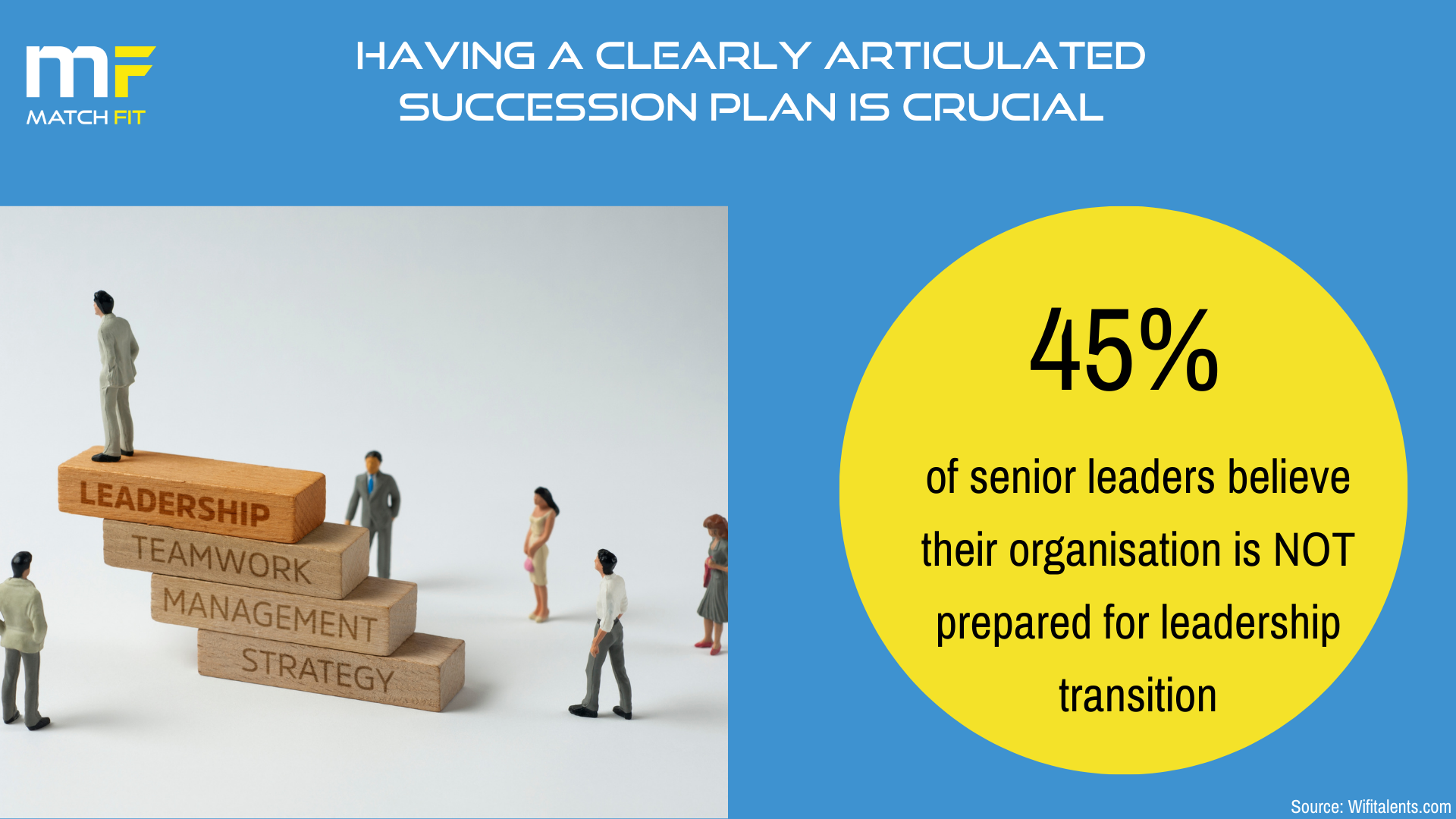
In this environment, the organisation’s narrative must move faster than speculation — and it must be supported by visible governance strength and a credible, clearly articulated succession plan.
The Opportunity Within Disruption
Handled poorly, leadership change leads to drift, talent flight and cultural fragmentation.
Handled well, it becomes a moment to:
- Reset cultural expectations
- Strengthen governance discipline
- Clarify strategic focus
- Reinforce collective leadership
The first 90 days determine the trajectory.
Final Thought
Leadership departure is not just a governance event, it’s a human event and we need to reframe it in this way.
Sustaining performance through transition requires more than process. It requires psychological stability, executive alignment and cultural clarity.
From my perspective, organisations that manage both the operational and emotional dimensions of change are the ones that emerge stronger not simply intact.
Building that level of resilience does not begin at the point of crisis. It is developed deliberately, by aligning leadership behaviour, strengthening trust and embedding cultural clarity across the organisation — the focus of our MatchFit CLIMB Programme.
Find out more information about the author, Bradley Honnor, MatchFit’s Managing Director
https://matchfitclimb.com/bradleyhonnor/
Sources:
**https://wifitalents.com/succession-planning-statistics/
Contact bradley@matchfitclimb.com if you would like to know more about how our programmes can help manage successful leadership transitions within organisations.