
Bradley Honnor, Managing Director of MatchFit, shares his perspective on whether culture is replacing DEI — or revealing where DEI, as it is often practised, has fallen short.
For me, the real question isn’t whether DEI matters — it’s whether our cultures are actually designed to make people feel included.
Introduction: Why This Question Is Being Asked Now
Over the last few years, Diversity, Equity and Inclusion (DEI) has rightly moved from the margins to the boardroom. For many organisations, it has become a moral imperative, a reputational issue, and a strategic priority. And that matters. The intention behind DEI — fairness, opportunity, belonging is important and necessary.
Yet at the same time, I increasingly hear a quiet question being asked behind closed doors: Is this actually working?
Not because people no longer care about inclusion, but because many organisations are struggling to translate good intentions into lived experience. There is fatigue. There is defensiveness. There is confusion about return on investment. And in some cases, there is a sense that DEI has become polarised, symbolic or disconnected from day-to-day reality.
Alongside this, another conversation has been gaining momentum — about culture. Culture is increasingly cited as the real driver of engagement, belonging and performance. Not what is written in policies or values statements, but how people actually experience work.
And this is where the real tension emerges.
Not whether DEI should exist — but whether culture is the missing link between DEI intent and DEI impact.
What DEI Was Meant to Achieve and Where It Struggled
At its core, DEI was designed to address inequality, underrepresentation and exclusion. It sought to give voice to those who had historically been marginalised and to create fairer access to opportunity. That intention remains valid.
However, in practice, many DEI initiatives have struggled because they have been treated as programmes rather than systems, often owned by HR rather than leadership, and frequently measured through metrics that don’t capture lived experience.
One of my longstanding concerns is that diversity and inclusion are often addressed in a way that unintentionally divides people into categories and boxes — gender, ethnicity, sexuality, age — and then asks those groups to speak about ‘their experience’.
The problem is that no group is homogeneous. A white, heterosexual woman will experience the workplace very differently from a disabled woman or a woman of colour. When we talk about ‘women’s experiences, who exactly are we talking about?
And just as importantly, when conversations are framed around groups, those outside the group can feel excluded from the discussion altogether. As a man, if we are talking about women’s experiences, I may feel I have nothing to contribute — even though inclusion is something we all participate in, every day.
When we move away from the individual experience and towards polarised group identities, conversations can quickly become defensive rather than curious. That is rarely the foundation for meaningful change.
DEI can set goals. But culture determines behaviour.
What Do We Really Mean by Organisational Culture?
Culture is often reduced to posters on walls, purpose statements and values decks. In reality, culture is much simpler and much harder.
Culture is how things really get done around here.
It shows up in everyday moments:
- Who gets listened to in meetings
- Whose ideas are challenged or dismissed
- Who is trusted with opportunity
- What behaviours are rewarded, ignored or quietly discouraged
Culture is not neutral. It either amplifies inclusion or undermines it.
From a psychological perspective, this matters because humans have a deep, innate need for belonging. We are social beings. We want to feel part of a group, a community, a ‘tribe’. When we feel excluded, even subtly, our nervous system responds with threat. Engagement drops. Creativity shuts down. People protect themselves.
Inclusion, therefore, is not just a moral concept. It is a human one.
Why Culture Is Where DEI Succeeds or Fails
Inclusion is not created by policies. It is created by behaviours.
I often reflect on how little we are taught about listening. In school, we learn to debate. We learn to defend a position. But we are rarely taught to listen openly — without preparing our response before the other person has finished speaking, without relating everything back to ourselves, and without judgement.
The psychologist Carl Rogers used principles such as unconditional positive regard in conflict mediation, even between deeply opposed groups. His work showed that when people feel genuinely heard and understood, polarisation softens and new understanding becomes possible.
This is deeply relevant to organisations today. When people do not feel listened to or psychologically safe, trust erodes — and without trust, inclusion cannot exist. The Edelman Trust Barometer 2025 highlights a growing trust gap between leaders and employees, with clear implications for engagement, retention and performance. I explore this in more depth, along with practical steps leaders can take, in my latest blog on closing the trust gap.
If leaders cannot create environments where people feel safe to speak, to disagree, to be different — then no amount of DEI policy will create inclusion. Culture is where intent becomes reality.
From Representation to Experience
Much of the DEI conversation has focused on representation — who is in the room. Representation matters. But it is only the starting point.
The more important question is: what does it feel like to be in the room?
Belonging, trust and fairness are not abstract ideas. They are experiences. And when people don’t experience them, they leave, quietly or otherwise.
One of the most honest measures of inclusion is not hiring, but retention. Diverse talent does not leave organisations because of a lack of policies. They leave because of culture.
There is also a tendency to frame inclusion from a deficit position: ‘How can we be more inclusive?’ That question subtly implies that we are failing.
An alternative and more constructive approach is to ask:
- Where does inclusion already work here?
- When have people felt most valued?
- What behaviours created that experience?
Culture change is often about amplifying what already works, not endlessly focusing on what doesn’t.
Leadership: Culture Is Not Neutral
Leaders shape culture whether they intend to or not. Every reaction, every decision, every silence sends a signal.
Leaders are often promoted for expertise, results or technical competence — not for their ability to create psychological safety or foster belonging. Yet those capabilities increasingly determine whether teams thrive or disengage.
Culture is not an HR initiative. It is a leadership capability.
Inclusion becomes sustainable only when leaders are accountable not just for what is achieved, but for how it is achieved and how people experience working with them.
A Practical Example: Age Diversity and Culture
Age diversity offers a useful lens for understanding why culture matters more than categorisation.
Today’s organisations often include employees in their 20s working alongside colleagues in their 60s and beyond. Each group brings different expectations, shaped by their social and technological context.
- Baby boomers may value loyalty and hierarchy
- Gen X independence and pragmatism
- Millennial’s purpose and feedback
- Gen Z inclusivity and rapid development
Trying to manage this through labels alone creates division. Culture, however, provides the unifying force.
A shared purpose —one that helps people see how their work contributes to something larger, transcends generational differences. When people understand why their work matters, they engage despite different personal expectations.
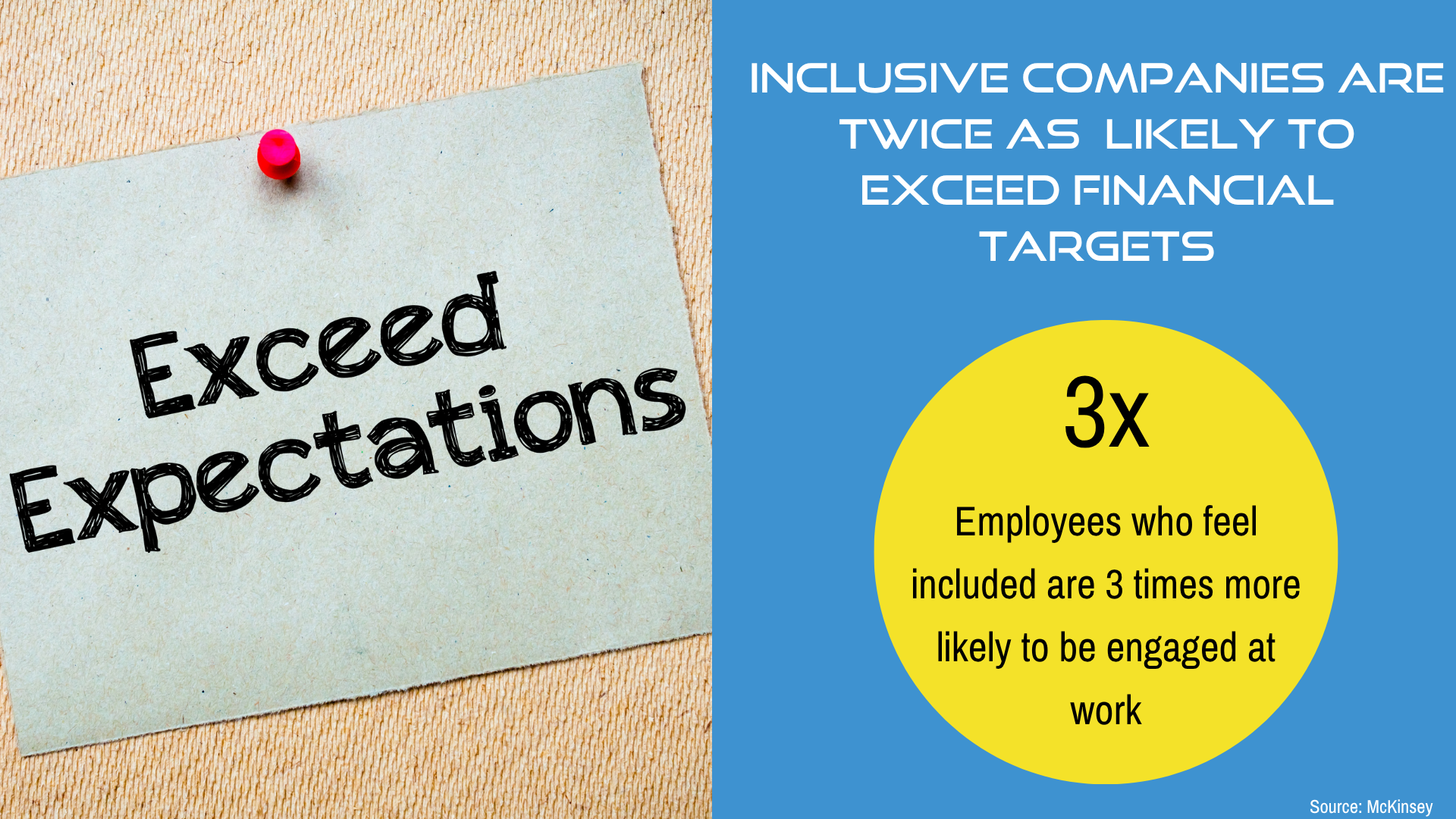
A growing body of research shows that organisations with strong, inclusive cultures deliver better business outcomes. Companies with diverse leadership teams are significantly more likely to deliver above-average profitability, while inclusive cultures have been linked to greater innovation, agility and better overall performance. Source: McKinsey insights
Is Culture Replacing DEI — or Completing It?
Culture is not a substitute for DEI frameworks, data or accountability. Representation still matters. Equity still matters. Measurement still matters.
But without culture, DEI becomes fragile. Transactional. Vulnerable to political shifts and fatigue.
The most effective organisations do not choose between DEI and culture. They integrate them:
- DEI sets direction and accountability
- Culture embeds behaviours
- Leadership sustains both
Culture is not an escape from DEI. It is what makes DEI durable.
Conclusion: Culture as the Next Evolution of DEI
DEI is not going away. It is growing up.
If the first phase of DEI was about awareness and representation, the next phase is about experience and behaviour. About how inclusion is lived, not just stated.
Culture is where intent becomes impact. Where belonging becomes real. Where performance follows.
Organisations that focus on culture do not abandon DEI. They finally give it the conditions it needs to succeed — moving beyond initiatives to embed inclusive behaviours into leadership, decision-making and everyday interactions.
This is the focus of our MatchFit CLIMB Programme: supporting organisations to build sustainable, high-performing cultures by aligning leadership behaviour, trust and inclusion with real business outcomes. When culture is treated as a strategic capability rather than a side project, DEI stops being fragile — and starts driving lasting change.
Find out more information about the author, Bradley Honnor, MatchFit’s Managing Director
https://matchfitclimb.com/bradleyhonnor/
Contact bradley@matchfitclimb.com if you would like to know more about how our programmes can help manage successful leadership transitions within organisations.