
Bradley Honnor, Managing Director of MatchFit, explores why workplace stress continues to rise despite growing investment in wellbeing initiatives, arguing that the root cause is often culture, not just individuals.
Workplace stress isn’t a small issue. It’s one of the biggest challenges facing organisations today. According to the Health & Safety Executive (HSE) in 2024/25, stress, depression and anxiety accounted for 22.1 million working days lost in the UK. On average, each person affected took 22.9 days off work.
At the same time, the Trade Union Council (TUC) reports that days lost to work-related ill health have increased by a third since 2010. For businesses, the cost is huge. Estimates suggest workplace stress, depression and anxiety cost UK organisations between £42 billion and £56 billion annually.
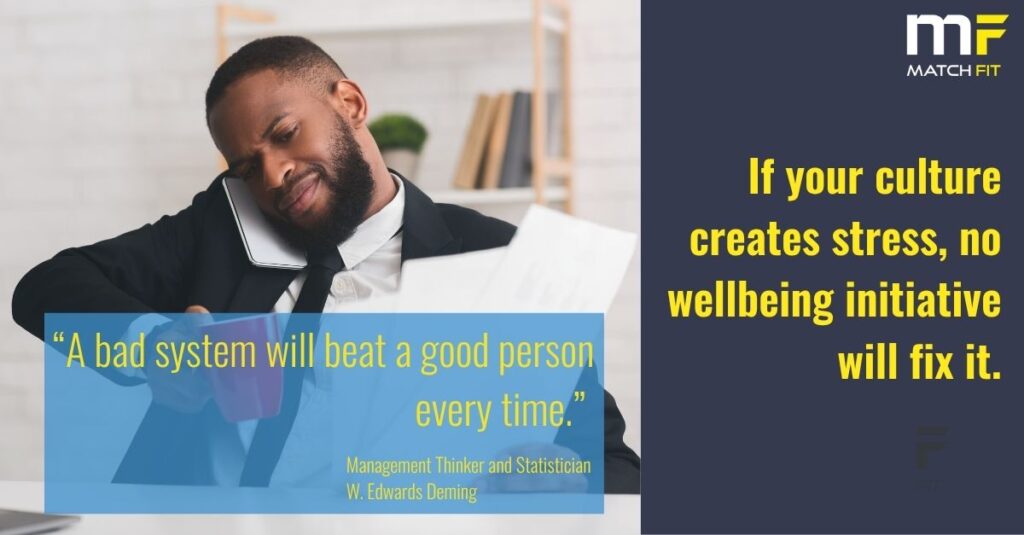
I’ve seen many organisations still trying to solve the problem with surface-level wellbeing initiatives, but the reality is simple: If your culture creates stress, no wellbeing initiative will fix it.
As management thinker and statistician W. Edwards Deming put it “A bad system will beat a good person every time.” In other words, if the environment people are working in is the problem, focusing only on the individual won’t solve it.
Let’s look at the real causes of workplace stress
Stress at work doesn’t appear out of nowhere. It’s usually driven by a combination of factors:
- Excessive workload and unrealistic expectations
- Poor or inconsistent management
- Job insecurity and lack of clarity
- Toxic environments, low trust and lack of recognition
All of these matter, but in practice, they often point back to one root cause: culture.
A stressful culture creates everything else. It drives poor management behaviours, increases uncertainty, and leads to burnout.
Why culture matters more than programmes
Many organisations invest in wellbeing programmes such as apps, workshops, benefits. These can help, but only at the edges.
If people are working in an environment where:
- They don’t feel safe to speak up
- Expectations are unclear or constantly shifting
- Leaders don’t role model healthy behaviours,
then no initiative will offset that. Wellbeing is not a programme, it’s an outcome of how people experience work every day.
What needs to change
To reduce stress in a meaningful way, organisations need to address the root causes.
That means:
- Understanding what’s really happening
Identifying sources of pressure such as conflict, unrealistic demands or unclear priorities - Equipping leaders and managers
Helping them create environments built on trust, clarity and open communication - Embedding behaviour change
Making wellbeing part of how work gets done, not an add-on
As explored in our thinking on wellbeing and leadership, real change happens when leaders take responsibility for the environment they create—not just the results they deliver.
The growing pressure of AI and pace
This is a theme I see coming up more and more in conversations with people at every level of the organisation. Alongside existing pressures, the pace of change, particularly driven by AI, is adding another layer.
AI is accelerating how we work—but it’s not changing how we’re wired as humans.
This creates new risks:
- Teams operating at or near cognitive overload
- Constant pressure to move faster and do more
- Changing expectations around productivity and availability
- ‘Invisible burnout’ in high-performing individuals
Technology has always introduced stress and now AI is simply accelerating it.
I believe the organisations that succeed will recognise a simple truth—performance is not just about time; it is about energy. Leaders need to create clarity rather than noise and build team environments that support people to perform at their best and recover effectively.
Leadership is the difference
There is strong evidence that improving employment standards improves wellbeing, health and productivity. In fact, according to the TUC, 75% of managers believe strengthened employment rights would improve employee health. But policies alone aren’t enough.
Culture is shaped by leadership behaviours:
- What gets rewarded
- What gets ignored
- How people are treated day to day
If leaders don’t create psychological safety, trust and clarity, stress will persist—regardless of any initiative.
#BeTheChange: where responsibility starts
2026 Stress Awareness Month’s theme, #BeTheChange, is a reminder that change doesn’t come from waiting, it comes from action.
We often wait for organisations, leaders or systems to improve. But meaningful change starts with individuals—through how we think, act and connect with others.
- Our brains can adapt and rewire (neuroplasticity)
- We have more control than we think (self-efficacy)
- We perform better when we feel connected (relational wellbeing)
Culture is built through these everyday interactions.
A different approach to change
At MatchFit, our ‘Phenomenlogical approach’ focuses on the lived experience of individuals and teams and is grounded in understanding that everyone experiences the same environment differently. Two people in the same team can have completely different experiences of stress, pressure and support.
That’s why real change comes from working in the ‘here and now’ and understanding behaviours, dynamics and perceptions as they happen.
By doing this, organisations can:
- Shift how people see themselves and their capabilities
- Improve communication and team dynamics
- Build environments where people take ownership and responsibility
- Create sustainable cultural change
Final thought
Wellbeing is not something you can bolt on. It’s created by the expectations you set, the behaviours you tolerate, and the environment leaders create every day.
If your culture creates stress, no wellbeing initiative will fix it. But if you get culture right, wellbeing follows.
Find out more information about the author, Bradley Honnor, MatchFit’s Managing Director
https://matchfitclimb.com/bradleyhonnor/
Contact bradley@matchfitclimb.com if you would like to know more about how our programmes can help improve workplace stress and develop a high-performance culture in your organisation.