
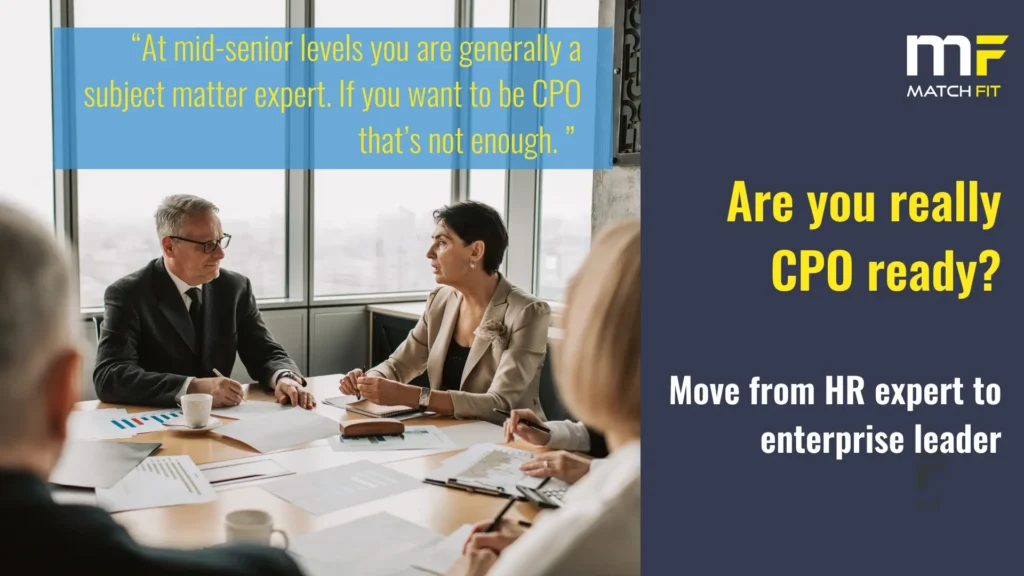
Are you really CPO ready? How to move from HR expert to enterprise leader
A lot of senior HR leaders quietly ask themselves the same question: Could I actually step into a Chief People Officer role?
They have the experience. They understand HR inside out. They have led major people programmes, managed difficult employee issues and earned the respect of senior colleagues.
Yet when a Chief People Officer (CPO) opportunity appears, it can move remarkably quickly. The person who gets the role is often someone who was already seen as capable of operating at that level long before there was a vacancy. That is the important distinction.
The CPO chair does not simply go to the best HR technician. It goes to someone who can operate as an enterprise leader who happens to have deep expertise in people.
Becoming CPO ready therefore requires a mindset shift. Your focus moves from managing HR exceptionally well towards understanding how talent, leadership, culture and organisational capability can deliver the business strategy.
Depth is essential, but it is only the beginning
Strong HR expertise matters.
You need credibility built through experience across areas such as talent, recruitment, learning, employee relations, organisational development and HR operations.
In a recent conversation about CPO readiness, our consultant stated:
“At mid-senior levels you are generally a subject matter expert. But if you want to be the CPO, that’s not enough.”
A useful way of thinking about this is the idea of the T shaped leader.
McKinsey describes a T shaped skills profile as having a broad set of generally applicable capabilities combined with a deep area of specialist expertise.
In simple terms, imagine the letter T.
The vertical part represents your depth. For an aspiring CPO, that is your HR expertise.
The horizontal part represents your breadth. It is how well you understand the rest of the organisation, the competition and the market.
That means knowing how the company makes money, where value is created, who its customers are, what competitors are doing and where the organisation is vulnerable. You should understand finance, operations, technology and risk well enough to participate meaningfully in conversations about them.
I have worked with CPOs who can talk confidently about the operating model, technology, market conditions and customer priorities of their organisation. They understand the business as a whole.
That is the transition. “If you don’t have that, you’re not CPO ready.”
That shift is not unique to HR. Moving into the C Suite changes what is expected of any senior leader. Expertise may earn you the opportunity, but success at executive level depends on your ability to think beyond your function, understand how the organisation creates value and contribute confidently to enterprise decisions. Our CLIMB Ready for C Suite programme is designed to help senior leaders prepare for that transition.
Develop an enterprise voice that shows your CPO ready
CPO readiness changes the way you contribute around the senior leadership table.
You stop seeing yourself principally as the person representing HR. You start thinking like someone who is collectively responsible for the success of the enterprise.
That changes the questions you ask:
- What is the organisation trying to achieve?
- Where could capability prevent us getting there?
- What talent will we need?
- Where are our leadership risks?
- What is happening to productivity?
- Which behaviours will support the strategy?
- Where is poor management creating cost or risk?
- Where can I actively drive business performance through people, rather than simply manage the people agenda
Your people strategy should become inseparable from the business strategy.
If the organisation is pursuing growth, what does that mean for talent?
If it is transforming its operating model, what leadership capabilities will be needed?
If margins are under pressure, where can better management improve productivity?
A CPO ready leader can make those connections clearly.
Skill matters. So does will and the right mindset
There is another part of this transition that receives less attention. Mindset.
In my experience, there are two broad reasons people do not make the move to CPO.
“You’ve got to have the will, and you’ve got to develop the skill to be a CPO. Some people don’t make the transition because they don’t want it enough. Some people don’t make the transition because they just haven’t got the skill, and they’re not learning it.”
There are many highly capable HR leaders who could progress further and often what gets in the way is confidence.
Imposter syndrome can become particularly powerful as people approach executive roles. These leaders convince themselves that everyone else in the room knows something they do not.
“The sad thing about imposter syndrome, very often people are very, very capable and could quite easily do what they’re thinking they can’t.”
Self-awareness matters here.You need an accurate view of your strengths, your gaps and the impact you have on other people. You also need enough belief in your capability to step forward when the opportunity comes.
Pay attention to how you show up
Executive presence can sound slightly mysterious.
For me, it comes down to credibility, authority and the confidence people have in you when the stakes rise.
“You need to have gravitas. You need to be able to present yourself as an executive. You need to have authority.”
Ask yourself a simple question: What three words would people use to describe me today?
Then ask: Are those the three words I want associated with me as a future CPO?
Getting feedback is invaluable and coaching can help. A good mentor can challenge assumptions you may have carried for years.
The key is to become intentional about your leadership presence and personal brand rather than hoping it develops automatically with seniority.
Get out of the HR bubble
Business breadth rarely arrives through another HR qualification.You have to go looking for it.
- Invite yourself into conversations across the organisation.
- Spend time with finance.
- Join a sales meeting.
- Understand what the operations team worries about.
- Speak to technology leaders about the decisions they face.
One of the simplest approaches is also one of the most effective:
“I don’t really know how this works. Could I borrow an hour of your time and you talk me through it? And offer to buy them a sandwich!”
Most people are surprisingly generous when somebody shows genuine curiosity about their work.
Attend a sales away day and stay for the wider discussion. Shadow somebody preparing a major customer pitch. Ask finance to walk you through the commercial model. Learn how your organisation assesses risk.
Networking should not begin when you suddenly need somebody, it should be an intentional part of understanding the enterprise.
Make HR commercially visible
One criticism frequently directed at HR is that its contribution can feel difficult to quantify. And that is a problem CPO ready leaders need to solve.
Marketing teams are routinely expected to discuss return on investment, pipeline and conversion. HR should be equally capable of connecting its work to measurable organisational outcomes.
That could mean productivity, succession readiness, internal mobility, retention in critical roles, management effectiveness or reductions in grievances.
Talk confidently about the commercial impact of your people strategy. Use dashboards to track KPIs and map major HR initiatives to specific business objectives (growth, margin, risk, customer, transformation).
At MatchFit, measurement is central to how we approach leadership development. We look at reaction, new understanding, behavioural change and business results because development has greater credibility when organisations can see what changed as a consequence.
As Lyn McDonald OBE, Director at the Cabinet Office, said of MatchFit:
“Their bespoke interventions have not only improved our team’s productivity but also enhanced our overall business performance.”
That commercial connection matters.
Treat your employer brand as a business issue
Talent also has a market as the best people make choices about where they want to work, just as customers decide where they want to spend their money.
Your employer brand therefore deserves executive attention.
CIPD defines the employee value proposition as what an organisation stands for, requires and offers as an employer. It is a useful reminder that your reputation as an employer comes from the reality people experience as much as the message you promote.
A CPO ready leader should understand what attracts critical talent, why strong people stay and what the external market thinks about the organisation.
That means working closely with marketing, listening to employees and paying attention to external reputation through platforms such as Glassdoor.
Learn to lead through change
CPOs rarely inherit a static organisation. Growth, restructuring, technology, AI, new operating models and changing customer expectations mean organisations are continually moving.
The CPO therefore needs to be capable of helping people manage uncertainty while keeping the organisation moving towards its strategic goals.
That sometimes requires consultation and careful listening. At other moments, the organisation needs clarity and decisive action.
Enterprise leadership means judging what the situation requires and it also means making decisions for the benefit of the whole organisation rather than protecting the interests of your own function.
Start before the vacancy exists and act like you’re already in the role
Perhaps the biggest mistake an aspiring CPO can make is waiting for a CPO vacancy before beginning this development. By then, it may be too late.
“The preparation could be a year or more. The board doesn’t want someone on a long learning curve.”
The strongest candidates are usually already behaving at the next level. They understand how the enterprise works, have built strong relationships across the organisation and can articulate the commercial contribution of the people agenda. They are respected outside HR, bring informed ideas to senior conversations and have developed the presence to operate credibly with the board.
In other words, they are already acting like enterprise leaders before they have the title. That means building breadth, visibility and influence well in advance of an opportunity appearing, so that when the role becomes available, others can already imagine you in it.
The same principle applies across senior leadership. As we explored in When the CEO Leaves: The People Risk Most Organisations Underestimate, unexpected leadership departures quickly expose whether an organisation has genuinely developed succession capability or simply assumed its key people will stay.
So ask yourself one final question:
If my CPO left unexpectedly tomorrow, would the CEO and board see me as an obvious option?
If the answer is not yet, turn that answer into a development plan.
Choose two or three moves you can make during the next 90 days.
- Build your understanding of a part of the business you currently know little about.
- Develop a relationship with a senior leader outside HR.
- Find a clearer way of demonstrating the commercial impact of one of your major people priorities.
CPO readiness is not a title you suddenly acquire. It is the cumulative result of intentional learning, behaviour and influence, and also how you show up and the value you create across the enterprise.
Ready to assess where you stand?
Download the MatchFit CPO Readiness Guide
Find out more about how we can support your CPO readiness and ensure you’re all set to become a Chief People Officer.
Contact bradley@matchfitclimb.com or visit our CLIMB Ready for C-suite page.
Are you really CPO ready? How to move from HR expert to enterprise leader Read More »